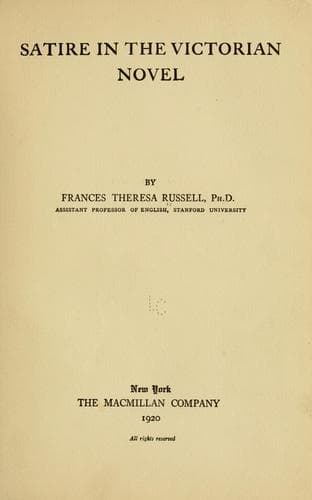
Satire in the Victorian novelRussell, Frances Theresa
History
Satire in the Victorian novel
Russell, Frances Theresa
English fiction -- 19th century -- History and criticism; Satire, English -- History and criticism; Thesis (Ph. D.)
“I know, dear ladies, that you are angry at this statement.
But, even at the risk of displeasing _you_, we must tell
the truth. You would wish to represent yourselves as equitable,
logical, and strictly just. * * * Women equitable, logical, and
strictly just! Mercy upon us! If they were, population would
cease, the world would be a howling wilderness.”
The apologist errs, however, in supposing that any ladies,--real or
fictitious, his own characters or others’,--are angry at his accusation
of injustice. Helen Pendennis, Amelia Sedley, even Ethel Newcome and
Lady Castelwood, would be flattered; Becky Sharp and Beatrix Esmond
would not care. And as for Caroline Helstone, Violet Effingham, Diana
Warwick, Sandra Belloni, they are too far away to be disturbed by
either smoke or aroma.
For half our novelists, the woman question as such did not exist,
and about the same number show little or no interest in the world of
fashion, though the two lists coincide only in part. Lytton, Thackeray,
Trollope, Meredith, and in a small way, Kingsley, have grudges against
society in addition to its treatment of women and women’s influence
on it; while Disraeli, Dickens, and Butler have some general gibes at
social follies.
From first to last in his near-half-century of writing, Lytton, himself
to the manner born, loved to prick the social bubble. In youth he
says:[279]
“The English of the fashionable world make business an
enjoyment, and enjoyment a business: they are born without a
smile; they rove about public places like so many easterly
winds--cold, sharp, and cutting; * * * while they have
neglected all the graces and charities of artifice, they have
adopted all its falsehood and deceit.”
Mr. Howard de Howard, rebuking a drawing room smart set, speaks for
himself and his class:[280]
“Gentlemen, I have sate by in silence and heard my king derided,
and my God blasphemed; but now when you attack the aristocracy,
I can no longer refrain from noticing so obviously intentional
an insult. _You have become personal._”
When young Chillingly absconds for a taste of real life, he leaves
a letter for his father in which he promises a safe return, and
adds,--[281]
“I will then take my place in polite society, call upon you
to pay all expenses, and fib on my own account to any extent
required by that world of fiction which is peopled by illusions
and governed by shams.”
In his first adventure, masquerading as a yeoman, he is quizzed by
Uncle Bovill on topics for the intelligent,--politics, agriculture,
finance. To maintain his incognito, he affects ignorance; and is
astonished at the triumphant deduction,--[282]
“Just as I thought, sir; you know nothing of these matters--you
are a gentleman born and bred--your clothes can’t disguise you,
sir.”
Public-domain text, read in full here on John Shaqi.
Reviews
Reviews
No reviews yet
Be the first to share your thoughts on this work.
Elsewhere in the archive
Join the Discussion
Join the discussion
Sign in to leave a comment or review.
Sign InorCreate an account