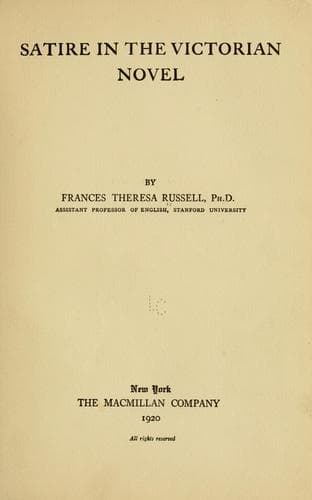
Satire in the Victorian novelRussell, Frances Theresa
History
Satire in the Victorian novel
Russell, Frances Theresa
English fiction -- 19th century -- History and criticism; Satire, English -- History and criticism; Thesis (Ph. D.)
“* * * he found that enormous beast comprehensible only when it
applauded him; and besides, he wished it warmly well; all that
was good for it; plentiful dinners, country excursions, stout
menagerie bars, music, a dance, and to bed; he was for patting,
stroking, petting the mob, for tossing it sops, never for
irritating it to show an eye-tooth, much less for causing it to
exhibit the grinders.”
Everard Romfrey, of sterner stuff, sees the advantage of tempering
mercy with justice:[298]
“To his mind the game-laws were the corner-stone of Law, and
of a man’s right to hold his own; and so delicately did he
think the country poised, that an attack on them threatened the
structure of justice. The three conjoined Estates were therefore
his head gamekeepers; their duty was to back him against the
poacher, if they would not see the country tumble. * * * No
tenants were forced to take his farms. He dragged no one by
the collar. He gave them liberty to go to Australia, Canada,
the Americas, if they liked. * * * Still there were grumbling
tenants. He swarmed with game, and though he was liberal, his
hares and his birds were immensely destructive: computation
could not fix the damage done by them. Probably the farmers
expected them not to eat. ‘There are two parties to a bargain,’
said Everard, ‘and one gets the worst of it. But if he was never
obliged to make it, where’s his right to complain?’ Men of sense
rarely obtain satisfactory answers; they are provoked to despise
their kind.”
He returns to the argument, deepened in unavoidable pessimism:[299]
“This behavior of corn-law agitators and protectors of poachers
was an hypocrisy too horrible for comment. Everard sipped
claret.”
The novels which depict the really acute phases of labor and
poverty,--_Sybil_, _Mary Barton_, _North and South_, _Shirley_, _Alton
Locke_, _Hard Times_, (diagnosed by Macaulay as “sullen socialism”),
_Put Yourself in his Place_, _Felix Holt_,--are apt to have John
Barton’s kind of laugh, if any, “a low chuckle, that had no mirth in
it.” But the author of the first of these puts into another story a
pungent little description:[300]
“The Elysians consisted of a few thousand beautified mortals,
the only occupation of whose existence was enjoyment; the rest
of the population comprised some millions of Gnomes and Sylphs,
who did nothing but work, and ensured by their labour the
felicity of the superior class.”
It is inevitable that the artist and the humorist should find their
most congenial fields in those relationships that are vital, and
not too hampered by the technique of more formal and crystallized
institutions. Prisons, Asylums, Courts, and the whole legal machinery,
offer a less inviting prospect than do political parties and theories,
and the contrast between social strata.
Public-domain text, read in full here on John Shaqi.
Reviews
Reviews
No reviews yet
Be the first to share your thoughts on this work.
Elsewhere in the archive
Join the Discussion
Join the discussion
Sign in to leave a comment or review.
Sign InorCreate an account