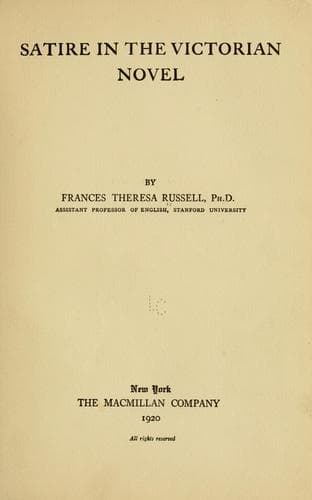
Satire in the Victorian novelRussell, Frances Theresa
History
Satire in the Victorian novel
Russell, Frances Theresa
English fiction -- 19th century -- History and criticism; Satire, English -- History and criticism; Thesis (Ph. D.)
It is not to be supposed, however, that the people would choose any
better than kings and parliaments; on the contrary,--[294]
“The Thirty at Athens were at least tyrants. They were
marked men. But the obscure majority, who, under our present
constitution, are destined to govern England, are as secret as a
Venetian conclave. Yet on their dark voices all depends.”
The trend of the succeeding novelists is toward a modified liberalism,
but Meredith is the only one to satirize the reactionary attitude as
such. The others throw the emphasis elsewhere. Besides, even such
humanitarians as Dickens, Gaskell, Reade, and Kingsley, are dubious as
to the remedial power of popular government, and seem inclined toward
Carlyle’s view of Chartism. What Chesterton says of one of them would
not be untrue applied to the rest:[295]
“All his grumblings through this book of _American Notes_, all
his shrieking satire in _Martin Chuzzlewit_, are expressions
of a grave and reasonable fear he had touching the future of
democracy.”
But the humanitarianism itself is sounded in a harmonious chord, whose
overtone is a ridicule, more grim than gay, of the delinquents;--those
who lack the spirit of humanity, yet are the very ones, on the
principle of _noblesse oblige_, in whom it should well up most
abundantly. If they fail through that ignorance and mental limitation
from which not even the aristocracy are always exempt, the blow is
tempered accordingly; but it falls more heavily when the roots of the
evil are the black ones of selfishness and perversity.
Lady Lufton, for instance, is a kind soul, who would have made
an excellent Providence, though scarcely adequate to cope with
the mismanagement of the Providence already installed over human
affairs:[296]
“She liked cheerful, quiet, well-to-do people, who loved their
Church, their country, and their Queen, and who were not too
anxious to make a noise in the world. She desired that all the
farmers round her should be able to pay their rents without
trouble, that all the old women should have warm flannel
petticoats, that the workingmen should be saved from rheumatism
by healthy food and dry houses, that they should all be obedient
to their pastors and masters--temporal as well as spiritual.
That was her idea of loving her country. She desired also that
the copses should be full of pheasants, the stubble-field of
partridges, and the gorse covers of foxes; in that way, also,
she loved her country.”
These are as amiable sentiments for a lady as Victor Radnor’s for a
gentleman. He is introduced as regretting his fall on London Bridge
chiefly because it led to an unpleasant altercation with a member of
the mob.[297]
Public-domain text, read in full here on John Shaqi.
Reviews
Reviews
No reviews yet
Be the first to share your thoughts on this work.
Elsewhere in the archive
Join the Discussion
Join the discussion
Sign in to leave a comment or review.
Sign InorCreate an account