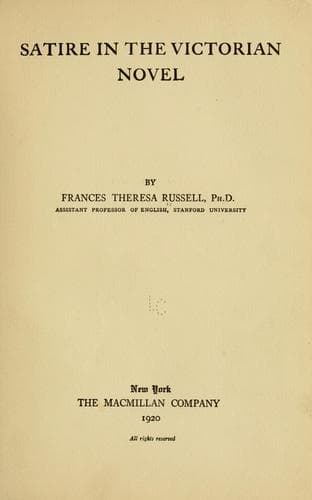
Satire in the Victorian novelRussell, Frances Theresa
History
Satire in the Victorian novel
Russell, Frances Theresa
English fiction -- 19th century -- History and criticism; Satire, English -- History and criticism; Thesis (Ph. D.)
“Barren of mental resources, too stupid to see, far less read,
the vast romance that lay all around him, every cell a volume;
too mindless to comprehend his own grand situation on a salient
of the State and of human nature, and to discern the sacred
and endless pleasures to be gathered there, this unhappy dolt,
flung into a lofty situation by shallow blockheads, who, like
himself, saw in a jail nothing greater or more than a ‘place of
punishment,’ must still like his prisoners and the rest of us
have some excitement to keep him from going dead. * * * Growth
is the nature * * * even of an unnatural habit. * * * Torture
had grown upon stupid, earnest Hawes; it seasoned that white of
egg, a mindless existence.”
The satisfaction one has in seeing him finally routed and dismissed is
enhanced by the manner of his exit. He is given permission to collect
his belongings before departure:--[303]
“‘I have nothing to take out of the jail, man,’ replied
Hawes rudely, ‘except’--and here he did a bit of pathos and
dignity--‘my zeal for Her Majesty’s service, and my integrity.’
“‘Ah,’ replied Mr. Lacy, quietly, ‘You won’t want any help to
carry them.’”
Next in order comes the “Visiting Injustice,” a purblind creature, who
sees only what the warden points out to him, and comforts a tortured
prisoner with pious exhortations to be patient and submit:[304]
“Item. An occasion for twaddling had come, and this good soul
seized it, and twaddled into a man’s ear who was fainting on the
rack.”
Later a sarcastic contrast is drawn between the dinner the official
enjoys at home and the convict’s gruel he had just ordered diluted.[305]
The first chaplain, well meaning and gentle, is also a failure, through
simple inanity:[306]
“Yet Mr. Jones was not a hypocrite nor a monster; he was only
a commonplace man--a thing moulded by circumstances instead of
moulding them. * * * But at the head of a struggling nation, or
in the command of an army in time of war, or at the head of the
religious department of a jail, fighting against human wolves,
tigers, and foxes, to be commonplace is an iniquity and leads to
crime.”
On the enlightened officialdom that permits all this, Reade is one
with Dickens. When an urgent appeal for investigation is sent to
headquarters, the reply is returned that the inspector would reach that
place in his normal circuit in six weeks:[307]
“‘Six weeks is not long to wait for help in a matter of life
and death,’ thought the eighty-pounders, the clerks who execute
England.”
Most unpardonable of all are such cases as Carter,--[308]
“* * * half-witted, half-responsible creatures, missent to jail
by shallow judges contentedly executing those shallow laws they
ought to modify and stigmatise until civilization shall come and
correct them.”
Public-domain text, read in full here on John Shaqi.
Reviews
Reviews
No reviews yet
Be the first to share your thoughts on this work.
Elsewhere in the archive
Join the Discussion
Join the discussion
Sign in to leave a comment or review.
Sign InorCreate an account