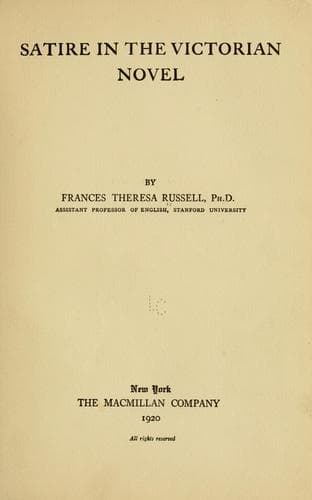
Satire in the Victorian novelRussell, Frances Theresa
History
Satire in the Victorian novel
Russell, Frances Theresa
English fiction -- 19th century -- History and criticism; Satire, English -- History and criticism; Thesis (Ph. D.)
The Bench and Bar are tempting game for those who enjoy the absurdity
of legal tricks and manners. Disraeli pursues it in the Camelopard
Court, in _Popanilla_; Dickens in _Pickwick_, _Old Curiosity Shop_,
_Bleak House_, _Our Mutual Friend_, not to mention the Circumlocution
and Prerogative Offices; Trollope in _Orley Farm_; and Butler in
_Erewhon_.
Furnival, attorney for the defence, makes an eloquent and persuasive
appeal in behalf of Lady Mason:[309]
“And yet as he sat down he knew that she had been guilty! * *
* and knowing that, he had been able to speak as though her
innocence were a thing of course. That those witnesses had
spoken truth he also knew, and yet he had been able to hold
them up to the execration of all around them as though they
had committed the worst of crimes from the foulest of motives!
And more than this, stranger than this, worse than this,--when
the legal world knew--as the legal world soon did know--that
all this had been so, the legal world found no fault with Mr.
Furnival, conceiving that he had done his duty by his client in
a manner becoming an English barrister and an English gentleman.”
Contempt for chicanery and injustice, scorn for downright oppression
and exploitation, are notes often sounded. Much more rare is an
expression of sympathy for aspiring but baffled mediocrity, with its
converse satire for those at fault. The most striking example is given
by Trollope. An introductory chapter, with a title and a refrain of
_Væ Victis_! is devoted to this subject:[310]
“There is sympathy for the hungry man, but there is no sympathy
for the unsuccessful man who is not hungry. If a fellow-mortal
be ragged, humanity will subscribe to mend his clothes; but
humanity will subscribe nothing to mend his ragged hopes so long
as his outside coat shall be whole and decent.”
This indictment is hung on the peg of the competitive examination, a
device satirized also by Peacock and Dickens, for being a pretentious
failure. Trollope concludes a sarcastic exhortation to all to persevere
in the mad scramble for capricious rewards, with this reflection:[311]
“There is something very painful in these races which we English
are always running to one who has tenderness enough to think of
the nine beaten horses instead of the one who has conquered.”
Public-domain text, read in full here on John Shaqi.
Reviews
Reviews
No reviews yet
Be the first to share your thoughts on this work.
Elsewhere in the archive
Join the Discussion
Join the discussion
Sign in to leave a comment or review.
Sign InorCreate an account