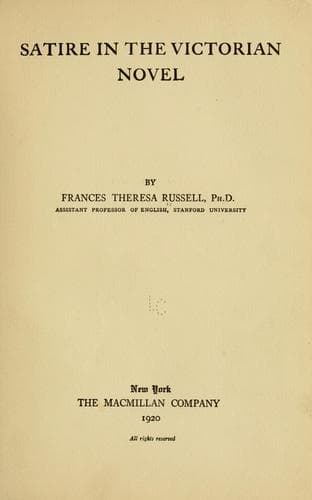
Satire in the Victorian novelRussell, Frances Theresa
History
Satire in the Victorian novel
Russell, Frances Theresa
English fiction -- 19th century -- History and criticism; Satire, English -- History and criticism; Thesis (Ph. D.)
“The voice of that sly little book was a honeyed voice; its
accents were all unction and balm. Here roared no utterance of
Rome’s thunders, no blasting of the breath of her displeasure. *
* * Far be it from her to threaten or to coerce; her wish was to
guide and win. _She_ persecute? Oh dear no! not on any account!
* * * It was a canting, sentimental, shallow little book, yet
* * * I was amused with the gambols of this unlicked wolf-cub
muffled in the fleece, and mimicking the bleat of a guileless
lamb. Portions of it reminded me of certain Wesleyan Methodist
tracts I had once read when a child; they were flavoured with
about the same seasoning of excitation to fanaticism. * * * I
smiled then over this dose of maternal tenderness, coming from
the ruddy old lady of the Seven Hills; smiled, too, at my own
disinclination, not to say disability, to meet their melting
favours.”
As her reason is not swayed by the arguments of the “Moloch Church,”
neither is her fancy kindled by its ritual:[328]
“Neither full procession nor high mass, nor swarming tapers, nor
swinging censers, nor ecclesiastical millinery, nor celestial
jewelry, touched my imagination a whit. What I saw struck me
as tawdry, not grand; as grossly material, not poetically
spiritual.”
Kingsley widens his criticism from the personal to the social point
of view. He objects to luxury not so much because it shows up the
luxurious as because it takes away even the necessities from those
who have not, to add yet more luxuries to those that have. He
questions--[329]
“* * * how a really pious and universally respected archbishop,
living within a quarter of a mile of one of the worst _infernos_
of destitution, disease, filth, and profligacy--can yet find
it in his heart to save £120,000 out of church revenues, and
leave it to his family; * * * how Irish bishops can reconcile
it to their consciences to leave behind them, one and all,
large fortunes * * * taken from the pockets of a Roman
Catholic population, whom they have been put there to convert
to Protestantism for the last three hundred years--with what
success, all the world knows.”
Moreover, because he sees in the church a possible vanguard to
civilization, he rebels against its retrogressive and obstructive
policy. He laments that the working men do not trust the clergy:[330]
Public-domain text, read in full here on John Shaqi.
Reviews
Reviews
No reviews yet
Be the first to share your thoughts on this work.
Elsewhere in the archive
Join the Discussion
Join the discussion
Sign in to leave a comment or review.
Sign InorCreate an account