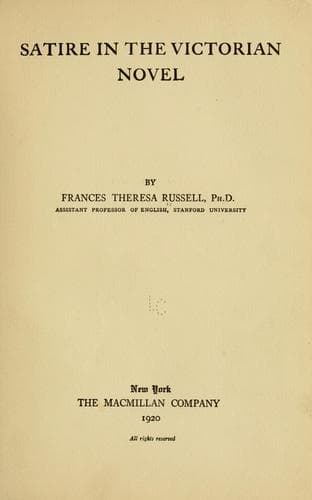
Satire in the Victorian novelRussell, Frances Theresa
History
Satire in the Victorian novel
Russell, Frances Theresa
English fiction -- 19th century -- History and criticism; Satire, English -- History and criticism; Thesis (Ph. D.)
“They suspect them to be mere tubs to the whale--mere
substitutes for education, slowly and late adopted, in order
to stop the mouths of the importunate. They may misjudge the
clergy; but whose fault is it if they do? * * * Every spiritual
reform since the time of John Wesley, has had to establish
itself in the teeth of insult, calumny, and persecution. Every
ecclesiastical reform comes not from within, but from without
your body. Everywhere we see the clergy, * * * proclaiming
themselves the advocates of Toryism, * * * chosen exclusively
from the classes which crush us down; * * * commanding us to
swallow down, with faith as passive and implicit as that of
a Papist, the very creeds from which their own bad example,
and their scandalous neglect, have * * * alienated us; * * *
betraying in every tract, in every sermon, an ignorance of the
doubts, the feelings, the very language of the masses, which
would be ludicrous, were it not accursed before God and man.”
Meredith expresses the same idea, with the difference that he does not
speak apologetically from within, but with the unqualified disapproval
of the outsider. Jenny Denham, an incisive and thoughtful woman,
says,[331]
“My experience of the priest in our country is, that he has
abandoned--he’s dead against the only cause that can justify and
keep up a Church; the cause of the poor--the people. He is a
creature of the moneyed class. I look on him as a pretender.”
In his subtle way Meredith satirizes the Catholic Church by having the
Countess de Saldar take refuge in and approve of it. Its great asset
is that its democracy includes even tailors. That it is the only true
spiritual home for a true gentleman she proves by citing an example.
A noble knight does not hesitate at telling a flat falsehood to save
a lady, being safe in morality because “his priest was handy.” Her
nature is defined as the truly religious, that is, one with need of
vicarious strength and a sense of renewed absolution. Another exponent
is Constance Asper, in _Diana of the Crossways_, whose boudoir was
filled with expensive Catholic equipments, affording “every invitation
to meditate in luxury on an ascetic religiousness.”
Public-domain text, read in full here on John Shaqi.
Reviews
Reviews
No reviews yet
Be the first to share your thoughts on this work.
Elsewhere in the archive
Join the Discussion
Join the discussion
Sign in to leave a comment or review.
Sign InorCreate an account