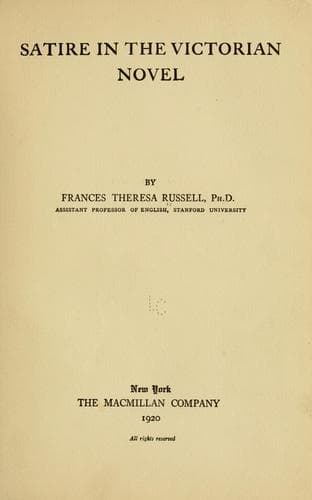
Satire in the Victorian novelRussell, Frances Theresa
History
Satire in the Victorian novel
Russell, Frances Theresa
English fiction -- 19th century -- History and criticism; Satire, English -- History and criticism; Thesis (Ph. D.)
In David Copperfield’s recollections of the metallic Murdstone, Arthur
Clennam’s of his childhood’s Sabbath and Alton Locke’s of his mother’s
fearful bigotry, we get glimpses into the pathos of the old Puritan
discipline. These are too sad for satire. Butler, no less sad, is also
angry enough to brand it with his caustic wit. Theobald and Christina
Pontifex are texts for a satiric sermon on parental incompetence, no
less disastrous although “All was done in love, anxiety, timidity,
stupidity, and impatience.” After the scene in which Theobald, having
punished little Ernest severely and quite wantonly, rang the bell for
prayers, “red-handed as he was,” his visitor reflects that perhaps it
was fortunate for his host--[337]
“* * * that our prayers were seldom marked by any very
encouraging degree of response, for if I had thought there was
the slightest chance of my being heard I should have prayed that
some one might ere long treat him as he had treated Ernest.”
The keynote of this most Christian system is unconsciously hit upon by
the bewildered little lad himself, who later concludes,--[338]
“* * * that he had duties towards everybody, lying in wait for
him upon every side, but that nobody had any duties towards him.”
Formal education naturally falls into the school and college divisions.
We have the former presented dramatically by Brontë in _Jane Eyre_
(and more impressionistically in _Villette_), by Thackeray in _The
Fatal Boots_ and _Vanity Fair_, by Butler in _The Way of All Flesh_,
and by the zealous specialist in that field. It has been counted up
that Dickens deals with twenty-eight schools and mentions a dozen
others.[339] The most important are in _Nicholas Nickleby_, _Dombey and
Son_, _David Copperfield_, and _Hard Times_.
Major Bagstock is contemplating young Rob, a product of that school
where they never taught honor, but were “particularly strong in the
engendering of hypocrisy,” and deduces that “it never pays to educate
that sort of people.” Whereupon--[340]
“The simple father was beginning to submit that he hoped his
son, the quondam Grinder, huffed and cuffed, and flogged and
badged, and taught, as parrots are, by a brute jobbed into his
place of schoolmaster with as much fitness for it as a hound,
might not have been educated on quite a right plan in some
undiscovered respect, when Mr. Dombey, angrily repeating ‘The
usual return!’ led the major away.”
Young David Copperfield profits little by losing Murdstone and gaining
Creakle. The aspect of this pleasant pedagogue so fascinates the gaze
of the boys that they cannot keep to their books. When a culprit is
called before the tribunal,--[341]
Public-domain text, read in full here on John Shaqi.
Reviews
Reviews
No reviews yet
Be the first to share your thoughts on this work.
Elsewhere in the archive
Join the Discussion
Join the discussion
Sign in to leave a comment or review.
Sign InorCreate an account