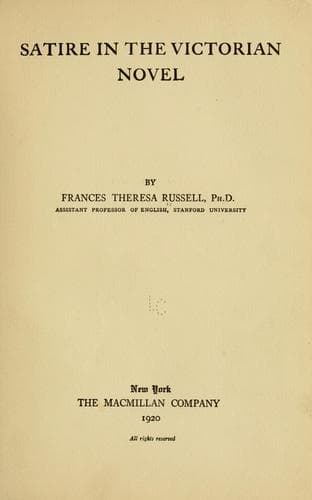
Satire in the Victorian novelRussell, Frances Theresa
History
Satire in the Victorian novel
Russell, Frances Theresa
English fiction -- 19th century -- History and criticism; Satire, English -- History and criticism; Thesis (Ph. D.)
“Mr. Creakle cuts a joke before he beats him, and we laugh at
it,--miserable little dogs, we laugh, with our visages as white
as ashes, and our hearts sinking into our boots. * * * Miserable
little propitiators of a remorseless Idol, how abject we were to
him! What a launch in life I think it now, on looking back, to
be so mean and servile to a man of such parts and pretensions!”
From this infant purgatory the step to the college seems a long one,
for that is by comparison an Elysium, however inane and frivolous.
Those whose satiric arrows speed thither are Peacock, Lytton, Trollope,
Kingsley, and Butler. Thackeray should be mentioned for his two
chapters on University Snobs, and the preceding one on Clerical
Snobs, in which he describes the colleges as the last strongholds of
Feudalism; concluding--[342]
“Why is the poor College servitor to wear that name and that
badge still? Because Universities are the last places into which
Reform penetrates. But now that she can go to College and back
for five shillings, let her travel down thither.”
Squire Headlong inquires in vain at Oxford for “men of taste and
philosophers.” Scythrop and Sir Telegraph were both cured at college
of their love for learning. Desmond describes the university system
as a “deep-laid conspiracy against the human understanding, * * * a
ridiculous and mischievous farce.” But Dr. Folliott refused to succumb.
Alluding to some one who cannot quote Greek, he adds,--[343]
“But I think he must have finished his education at some very
rigid college, where a quotation, or any other overt act showing
acquaintance with classical literature, was visited with a
severe penalty. For my part, I made it my boast that I was not
to be so subdued. I could not be abated of a single quotation by
all the bumpers in which I was fined.”
The same critic says elsewhere of the curriculum:[344]
“Everything for everybody, science for all, schools for all,
rhetoric for all, law for all, physic for all, words for all,
and sense for none.”
Pelham testifies that at Eton he was never taught a syllable of English
literature, laws, or history; and was laughed at for reading Pope out
of school. On his graduation from Cambridge, a place that “reeked with
vulgarity,” he is congratulated by his tutor for having been passably
decent. Whereupon he observes,--[345]
“Thus closed my academical career. He who does not allow that
it passed creditably to my teachers, profitably to myself, and
beneficially to the world, is a narrow-minded and illiterate
man, who knows nothing of the advantages of modern education.”
Public-domain text, read in full here on John Shaqi.
Reviews
Reviews
No reviews yet
Be the first to share your thoughts on this work.
Elsewhere in the archive
Join the Discussion
Join the discussion
Sign in to leave a comment or review.
Sign InorCreate an account