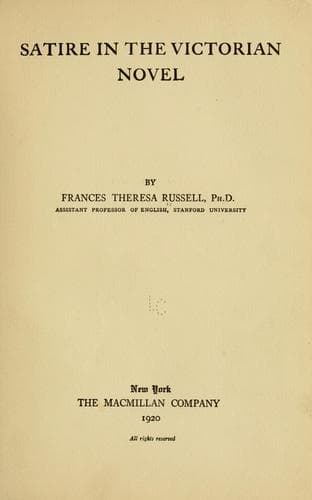
Satire in the Victorian novelRussell, Frances Theresa
History
Satire in the Victorian novel
Russell, Frances Theresa
English fiction -- 19th century -- History and criticism; Satire, English -- History and criticism; Thesis (Ph. D.)
The Honorable Mr. Listless finds the volumes of modern literature “very
consolatory and congenial” to his feelings:[347]
“There is, as it were, a delightful north-east wind, an
intellectual blight breathing through them; a delicious
misanthropy and discontent, that demonstrates the nullity of
virtue and energy, and puts me in good humour with myself and
sofa.”
Pelham perceives--[348]
“* * * an unaccountable prepossession among all persons, to
imagine that whatever seems gloomy must be profound, and
whatever is cheerful must be shallow. They have put poor
Philosophy into deep mourning, and given her a coffin for a
writing desk, and a skull for an inkstand.”
Ganymede anticipates that Apollo’s new poem will be very popular, for
“it is all about moonlight and the misery of existence.”[349]
It is in Meredith that we find the greatest point and depth in literary
criticism, as in most other things. Under cover of apology for his own
method of psychological analysis, he manages to convey his impression
of those who tell and who love the story for the story’s sake. He
cannot avoid, he explains, the slow start and detailed exposition in
which he unfolds the situation, and adds:[350]
“This it is not necessary to do when you are set astride the
enchanted horse of the Tale, which leaves the man’s mind at
home while he performs the deeds befitting him: he can indeed
be rapid. Whether more active, is a question asking for your
notions of the governing element in the composition of man,
and of his present business here. * * * All ill-fortuned
minstrel who has by fateful direction been brought to see with
distinctness that man is not as much comprised in external
features as the monkey, will be devoted to the task of the
fuller portraiture.”
It is Meredith also who says the last word on the English, as English.
They are indeed the real objects under all these disguises of their
activities, but they are not often synthesized and called by name.
Yet--[351]
“An actually satiric man in an English circle, that does not
resort to the fist for a reply to him, may almost satiate
the excessive fury roused in his mind by an illogical people
of a provocative prosperity, * * * They give him so many
opportunities.”
He seizes one of them by symbolizing England in the Duvidney sisters;
composed of such, it becomes--[352]
“* * * a vast body of passives and negatives, living by precept,
according to rules of precedent, and supposing themselves to be
righteously guided because of their continuing undisturbed. * *
* mixed with an ancient Hebrew fear of offense to an inscrutable
Lord, eccentrically appeasable through the dreary iteration of
the litany of sinfulness. * * * Satirists in their fervours
might be near it to grasp it, if they could be moved to moral
distinctness, mental intention, with a preference of strong
plain speech over the crack of their whips.”
Public-domain text, read in full here on John Shaqi.
Reviews
Reviews
No reviews yet
Be the first to share your thoughts on this work.
Elsewhere in the archive
Join the Discussion
Join the discussion
Sign in to leave a comment or review.
Sign InorCreate an account