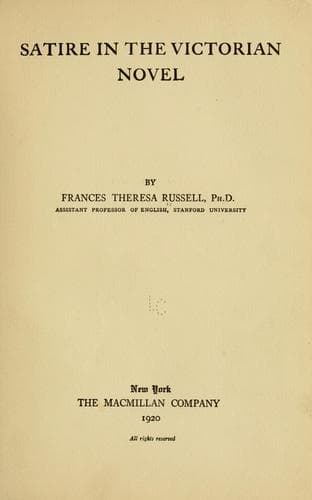
Satire in the Victorian novelRussell, Frances Theresa
History
Satire in the Victorian novel
Russell, Frances Theresa
English fiction -- 19th century -- History and criticism; Satire, English -- History and criticism; Thesis (Ph. D.)
Trollope in _The Bertrams_, and Kingsley in _Yeast and Alton Locke_,
have a few words for the subject, but add no new idea, except that
Alton voices the disgust of the students themselves with their Alma
Mater. It is this same young neophyte who is advised by Dean Winnstay
to go to some such college as St. Mark’s, which “might, by its strong
Church principles, give the best antidote to any little remaining taint
of sans-culottism.”
In Butler’s Erewhonian Colleges of Unreason the leading subject is
Hypothetics, and the most honored Chairs are those of Inconsistency and
Evasion, both required courses. Genius and originality are resolutely
discouraged, it being a man’s business “to think as his neighbors do,
for Heaven help him if he thinks good what they count bad.” These
Erewhonian professors, by the way, might have adduced as evidence the
well-known, horrified exclamation of Mary Shelley at the suggestion
that her son be sent where he would be taught to think for himself. By
refusing to “think like other people,” a man may become a poet and even
a beautiful, ineffectual angel, but he cannot lead a comfortable nor a
really effectual life. The problem as to who may safely be intrusted to
lead public opinion, and who are safest as followers, is an intricate
one, but it is certainly true that a sane and modest agnosticism is not
necessarily synonymous with “the art of sitting gracefully on a fence,”
which Butler concludes was brought to its greatest perfection in the
Colleges of Unreason.
On the subjects of Literature and the Press too much has been said
to be ignored, but not much of any great consequence. Trollope took
Journalism as a satiric province, with some little aid from Meredith.
He also takes a shot, not too well aimed, at the current humanitarian
fiction which purposes to set the world right in shilling numbers. He
adds,--[346]
“Of all such reformers, Mr. Sentiment is the most powerful. It
is incredible the number of evil practices he has put down. It
is to be feared he will soon lack subjects, and that when he
has made the working classes comfortable, and got bitter beer
put into proper sized pint bottles, there will be nothing left
for him to do. Mr. Sentiment is certainly a very powerful man,
and perhaps not the less so that his good poor people are so
very good; his hard rich people so very hard, and the genuinely
honest so very honest. * * * Divine peeresses are no longer
interesting, though possessed of every virtue; but a pattern
peasant or an immaculate manufacturing hero may talk as much
twaddle as one of Mrs. Ratcliffe’s heroines, and still be
listened to.”
A favorite theme, especially among the earlier writers, is the pose
of pessimism, alien to the self-satisfied optimistic spirit which
prevailed with little opposition--except from James Thompson and
Matthew Arnold--from Byron to Hardy.
Public-domain text, read in full here on John Shaqi.
Reviews
Reviews
No reviews yet
Be the first to share your thoughts on this work.
Elsewhere in the archive
Join the Discussion
Join the discussion
Sign in to leave a comment or review.
Sign InorCreate an account