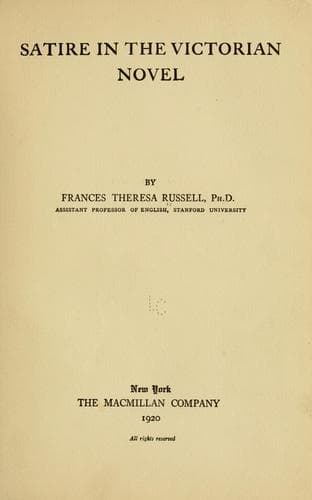
Satire in the Victorian novelRussell, Frances Theresa
History
Satire in the Victorian novel
Russell, Frances Theresa
English fiction -- 19th century -- History and criticism; Satire, English -- History and criticism; Thesis (Ph. D.)
Satire, being frankly a destructive process, makes no pretense of
supplementing its iconoclasm by reconstruction. But such implication of
reform as may lurk in the criticism that paves the way may be looked
for more assuredly than elsewhere in attacks on institutions. Such
criticism is neither lowered by the recrimination that puts satire
of individuals below the normal satiric level, nor elevated by the
artistic detachment that lifts satire of human nature above it. For
it is not in the too small lump of the solitary specimen that the
leaven can best work, nor yet in the too large mass of the whole human
race. It is in the unit between these two extremes, the body politic
or social or religious or educational, that it may best perform its
fermenting ministrations.
Even so, however, the idealism of the Victorian novelists did not
take this positive turn. English genius has on the whole contributed
its share to the anthology of Utopian vision, even to the furnishing
of the name, but the nineteenth century, preëminent in criticism and
speculation, venting more talk about it than all the other centuries
put together, has to its credit in this line, aside from _Erewhon_
and _The Coming Race_, only Morris’s _News from Nowhere_,
and that is too naïve in its simplification of human nature and too
absurd in its glorification of medievalism to be taken seriously.
More carefully thought out as an Ideal State, more searching in its
seriousness, more pertinent in its satire, and more constructive in
its conclusion, than any of these, is the American product, Bellamy’s
_Looking Backward_.
The Victorians did their looking backward literally from their own
present instead of an imagined future. And since in so doing they did
for the most part but cast their eye on prospects drear, and since they
shrank from a future they could only guess and fear if they thought
about it at all, they wisely and practically spent themselves on the
present. And because of this acceptance of the present and all its
institutions as a whole, they could couch their lances only against
this or that detail, not against the challenge of civilization itself.
The following instances show a characteristic difference in their
resemblance. “In England, poverty is a crime,” exclaims Lytton in the
nineteenth century. The observation is ironic, the tone scornful, and
the object of the ironic scorn is the snobbishness of those who from
the heights of wealth look down upon and despise the poor. The rebuke
is intended for the alien attitude toward that portion of society which
we may expect, according to Biblical authority, always to have with
us. Poverty itself is a mysterious dispensation, having indeed many
discernible compensations, and ever mitigable by applied morality.
Public-domain text, read in full here on John Shaqi.
Reviews
Reviews
No reviews yet
Be the first to share your thoughts on this work.
Elsewhere in the archive
Join the Discussion
Join the discussion
Sign in to leave a comment or review.
Sign InorCreate an account