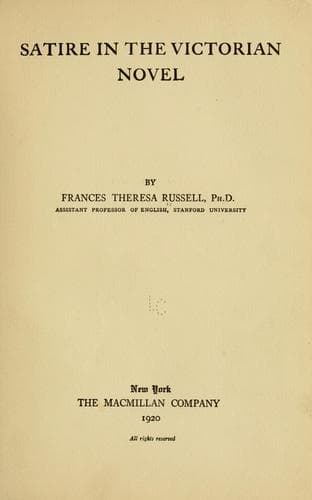
Satire in the Victorian novelRussell, Frances Theresa
History
Satire in the Victorian novel
Russell, Frances Theresa
English fiction -- 19th century -- History and criticism; Satire, English -- History and criticism; Thesis (Ph. D.)
“Poverty is the only crime,” echoes Bernard Shaw in the twentieth
century. His assertion is meant literally, the tone is decisive, and
the indictment is lodged against society at large for being so stupid
and inefficient as to permit such a canker, pernicious but curable, to
infect its body.
To remedy the supercilious attitude toward the poor is still to leave
poverty intact and in permanent possession of the field. To remedy the
criminal carelessness which tolerates its presence is to abolish the
thing itself.
But even if the twentieth century has stated the problem, it has not
yet solved it. And while neither the statement nor the solution of
the nineteenth is reckoned adequate today, still the Victorians did
accomplish something if not much, and all we can say for ourselves
is that we have not accomplished much, if something. Moreover, to
flatter ourselves that we are the first to discover the social onus of
poverty and other ills, is to ignore the contributions not only of the
novelists but of Carlyle, Ruskin, Morris, and Henry George. When the
remaining four-fifths of our century shall have been added to history,
we may perhaps applaud ourselves. At present it will do us no harm to
render unto Victorianism the acknowledgment that is its due.
CHAPTER III
TYPES
For that form of satire which deals with actual individuals,
photographed or caricatured, the designation _personal_ is sufficiently
descriptive. But for that which deals with fictitious individuals,
wherein the models that sat for the portraits have passed through
the imaginative process that makes their portraiture a work of
art, there is no satisfactory name. _Typical_, in distinction from
_individual_ and _institutional_, is tolerably expressive, but a term
to be apologized for. The school of art known as realistic, which was
theoretically adopted by the nineteenth century, repudiates creations
that are “mere types,” and claims for itself the achievement of true
individuals. The sign of individuality is a discordant complexity.
Every man may have his humour but he is not always in it. He may
be ruled by a master passion, but the rule is not a monopolistic
autocracy. Its supremacy is constantly disputed and threatened by mob
rebellion. Civil war is the usual rêgime, and the attainment of a
stabilized government is rare.
Tamburlaine, Volpone, Othello, Tartuffe, Blifil, are not untrue,
but they are only partial truths. We see much, undoubtedly the most
significant and dominating traits, but we cannot see all when the
searchlight is concentrated on a single spot. Agamemnon, Hamlet, Tom
Jones, Jaffeir, swayed, perplexed, inconsistent, at once infinite and
abject, are more nearly full length and complete drawings. Milton’s
Satan becomes humanized when, entering the human abode, he grows
hesitant, half regretful, half eager, a prey to conflicting emotions
and cross purposes.
Public-domain text, read in full here on John Shaqi.
Reviews
Reviews
No reviews yet
Be the first to share your thoughts on this work.
Elsewhere in the archive
Join the Discussion
Join the discussion
Sign in to leave a comment or review.
Sign InorCreate an account