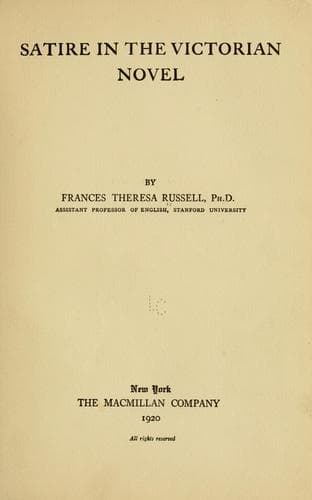
Satire in the Victorian novelRussell, Frances Theresa
History
Satire in the Victorian novel
Russell, Frances Theresa
English fiction -- 19th century -- History and criticism; Satire, English -- History and criticism; Thesis (Ph. D.)
Here, however, the sentimental fallacy is shown to be the reverse side
of the refusal to see what is, and to consist in the assertion of what
is not. This is a logical corollary, since merely to disregard the
unpleasant is a passive state until reinforced by the active process of
manufacturing the desirable. Actually to manufacture the desirable is a
constructive work, and the occupation of the enterprising idealist. The
sentimentalist manufactures only in fancy, and, being a sentimentalist,
does not know the difference. His imagination, that marvelous power of
visualizing the absent or non-existent, is perverted by being turned
inward and forced to rest content with its hollow fabrication, instead
of being directed outward upon a plastic world waiting its formative
touch. As the urge to an ideal of excellence is the most hopeful
quality of human nature, so the satisfied repose on the fictitious
supposition of such excellence is the most hopeless. Being, as Meredith
adds, “a perfectly natural growth of a fat soil,” it lacks the stimulus
of a rebuff that turns earth’s smoothness rough, and perceives no
necessity for striving or daring.
On this assertive side sentimentality is related to egoism. But the
relation is difficult to express, for egoism is another complexity that
baffles analysis. Self-respect and attention to one’s own affairs are
basic and indispensable virtues; while conversely, altruism is often
but egoism in disguise and of all things the most sentimental. We
may conclude, however, that it is egoism pushed to its two extremes,
vanity on the one side and selfishness on the other, that is the
satirizible sort. It is to the vanity wing that sentimentality is more
closely connected, as the assumption it makes is usually that of our
own superiority in possession and attainment, our own sincerity of
motive, and our own immunity from ordinary consequences. Such is the
attitude of the sentimental egoists, of which Meredith gives us a full
complement.
The Countess de Saldar is abused by the exposure of her schemes, but
resolute:[392]
“Still to be sweet, still to smile and to amuse,--still to give
her zealous attention to the business of the diplomatist’s
Election, still to go through her church service devoutly,
required heroism; she was equal to it, for she had remarkable
courage; but it was hard to feel no longer at one with
Providence.”
Wilfred Pole, by Wilming Weir in the moonlight, vows his love for
Emilia:[393]
“Having said it, he was screwed up to feel it as nearly as
possible, such virtue is there in uttered words.”
Edward Blancove is visited by the facile compunction that attacks
Arthur Donnithorne and others of the kind:[394]
“He closed, as it were, a black volume, and opened a new and
bright one. Young men easily fancy that they may do this,
and that when the black volume is shut the tide is stopped.
Saying ‘I was a fool,’ they believe they have put an end to the
foolishness.”
Public-domain text, read in full here on John Shaqi.
Reviews
Reviews
No reviews yet
Be the first to share your thoughts on this work.
Elsewhere in the archive
Join the Discussion
Join the discussion
Sign in to leave a comment or review.
Sign InorCreate an account