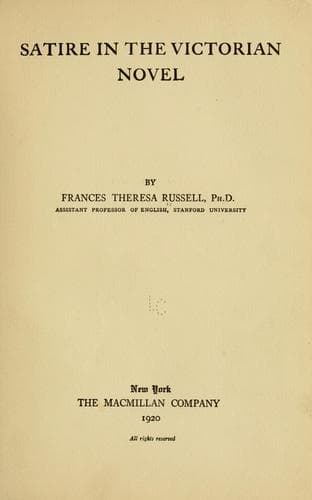
Satire in the Victorian novelRussell, Frances Theresa
History
Satire in the Victorian novel
Russell, Frances Theresa
English fiction -- 19th century -- History and criticism; Satire, English -- History and criticism; Thesis (Ph. D.)
Godfrey Cass, having little to say for himself, is drawn with much
sympathy, the responsibility being thrown upon his self-excusing
father:[388]
“The Squire’s life was quite as idle as his sons’, but it was
a fiction kept up by himself and his contemporaries in Raveloe
that youth was exclusively the period of folly, and that their
aged wisdom was constantly in a state of endurance mitigated by
sarcasm.”
In addition to these instances, and such casual phrases as, “that
softening influence of the fine arts which makes other peoples’
hardships picturesque,” and “that pleasure of guessing which active
minds notoriously prefer to ready-made knowledge,” George Eliot defines
sentimentality indirectly in the words of Mary Garth, an observant
young woman and something of a humorist in her own right:[389]
“* * * people were so ridiculous with their illusions, carrying
their fools’ caps unawares, thinking their own lies opaque while
everybody elses’ were transparent, making themselves exceptions
to everything, as if when all the world looked yellow under a
lamp they alone were rosy.”
The sentimentalist is rampant in Meredith’s novels, depicted in all his
aspects. The keynote is that the sentimental spirit may be arbitrarily
hospitable, not obliged to keep open house whither all truths may
turn for shelter. “Bear in mind,” he admonishes, “that we are
sentimentalists. The eye is our servant, not our master; and so are
the senses generally. We are not bound to accept more than we choose
from them.”[390]
It is in _Sandra Belloni_ that Meredith is most expository on
the subject, and in connection with the Pole sisters. He says of
them,--[391]
“It may be seen that they were sentimentalists. That is to say,
they supposed that they enjoyed exclusive possession of the Nice
Feelings, and exclusively comprehended the Fine Shades.” They
had “that extraordinary sense of superiority to mankind which
was the crown of their complacent brows. Eclipsed as they may
be in the gross appreciation of the world by other people, who
excel in this or that accomplishment, persons that nourish Nice
Feelings and are intimate with the Fine Shades carry their own
test of intrinsic value.”
Public-domain text, read in full here on John Shaqi.
Reviews
Reviews
No reviews yet
Be the first to share your thoughts on this work.
Elsewhere in the archive
Join the Discussion
Join the discussion
Sign in to leave a comment or review.
Sign InorCreate an account