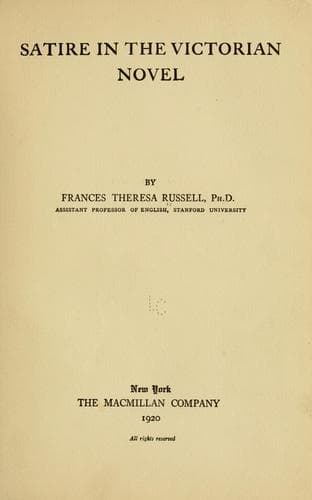
Satire in the Victorian novelRussell, Frances Theresa
History
Satire in the Victorian novel
Russell, Frances Theresa
English fiction -- 19th century -- History and criticism; Satire, English -- History and criticism; Thesis (Ph. D.)
Another and more passive type of the egoist is the epicurean. He
asks only to have his tastes gratified, and, being devoted to
material comfort, demands little of the world but material supplies.
Epicurianism is marked by an indulgent good-humor so long as it is
itself indulged, and when not gratified sinks into nothing worse
than peevishness. Though it may be a deplorable trait, it is not a
ridiculous one in itself, and is therefore satirized only when in
conjunction with something that produces an incongruity. The constant
stream of satire directed against the epicurean clergy, for instance,
is due to the sense of an incompatibility between a profession which
inculcates simplicity at least, if not actual asceticism, and a régime
of sensuous indulgence. Those who are legitimately worldly, as for
example the patrician triad depicted by Thackeray,--Miss Crawley,
the Countess of Kew, and Madam Bernstein,--may not be admirable, but
neither are they absurd.
In Adrian Harley we have the egoistic epicure in all his plump
perfection. Meredith hastens, however, to exculpate the founder of the
hedonistic philosophy:[398]
“Adrian was an epicurean; one whom Epicurus would have scourged
out of his garden, certainly; an epicurean of our modern
notions.”
The combination in him of cynic, self-pamperer, and Sir Oracle forms
a type which Meredith especially delights to dishonor, because its
own smugness puts a splash of color, as it were, on the bull’s-eye
and renders it more conspicuous. Not only is the epicure pierced
with many an ironic shaft, but the Wise Youth is made the veritable
error incarnate of the Feverel tragedy. For it was his Fabian policy,
dictated and obeyed, that knotted still more the sad tangle, just as
it was Austin Wentworth’s simple manly directness that proved the knot
could be cut easily by prompt and silent action. Indeed, in these two
characters we see exemplified throughout the story the false Florimell
of vanity and the true Florimell of pride,--the pride that is too proud
to do an unworthy or debasing deed, and the vanity that can counterfeit
successfully until confronted by the genuine reality.
Public-domain text, read in full here on John Shaqi.
Reviews
Reviews
No reviews yet
Be the first to share your thoughts on this work.
Elsewhere in the archive
Join the Discussion
Join the discussion
Sign in to leave a comment or review.
Sign InorCreate an account