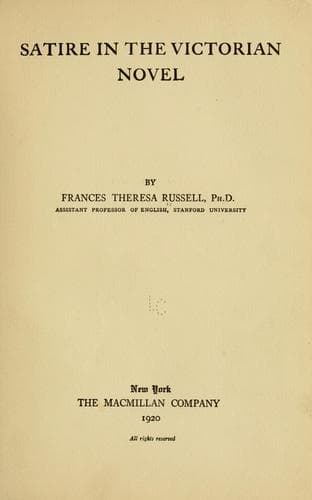
Satire in the Victorian novelRussell, Frances Theresa
History
Satire in the Victorian novel
Russell, Frances Theresa
English fiction -- 19th century -- History and criticism; Satire, English -- History and criticism; Thesis (Ph. D.)
Egoism within bounds is a perfectly sane and rational thing, but to
keep it within bounds is exceedingly difficult. When given over to an
irrational rule it grows into fanaticism. For the fanatic owes his
monomania to the force of a strong personality, which engenders the
unmitigated assurance of being right, plus the perverted reasoning that
characterizes the sentimentalist. He is always foolish, but seldom a
hypocrite, as his deception usually extends to himself. His selfishness
is of the opposite sort from the epicure’s. What he seeks is not a soft
berth and personal acquisitions, but a chance to impose his opinions on
a misguided world, and to dominate over converts or subjects. In his
milder moods he only dreams of happy schemes and far-reaching reforms,
but when charged with energy his proselyting zeal tends to make him
tyrannical.
In some form or other he appears on the pages of almost every Victorian
novelist. That the faddist is a favorite subject with Peacock is well
known. Lytton gives a delightful contribution in the Uncle Jack of _The
Caxtons_, whose “bewitching enthusiasm and convincing calculation” led
him into alluring speculations that invariably proved disastrous to the
members of his family. Not financial but missionary and philanthropic
zeal animate the souls immortalized by Dickens,--Mrs. Jellyby and Mrs.
Pardiggle, Reverend Honeythunder, and the Snagsbys. Brontë and Kingsley
specialize in the religious bigot. The former satirizes the Jesuit in
_Villette_, but not St. John Rivers, who is drawn seriously. The latter
gives a vivid picture in his Mrs. Locke and the Calvinistic preachers,
and another, of the opposite type, done with more partisanship and
less sympathy, in the vicar and Argemone in _Yeast_. Trollope is more
interested in the sociological zealot. He introduces him as the author,
Mr. Popular Sentiment; the “Barchester Brutus,” Mr. John Bold; the
demagogue, Ontario Moggs, son of a capitalist, and advocate of labor
unions; and some characters in the Parliamentary Series. A sample from
a harangue of Moggs will serve to illustrate the fair-mindedness that
accompanies Trollope’s love of parody. He quotes and then comments:[399]
“‘Gentlemen, were it not for strikes, this would be a country
in which no free man could live. By the aid of strikes we will
make it the Paradise of the labourer, and Elysium of industry,
an Eden of artisans.’ There was much more of it, but the reader
might be fatigued were the full flood of Mr. Moggs’s oratory to
be let loose upon him. And through it all there was a germ of
truth, and a strong dash of true, noble feeling; but the speaker
had omitted as yet to learn how much thought must be given to a
germ of truth before it can be made to produce fruit for the
multitude. And then, in speaking, grand words come so easily,
while thoughts--even little thoughts--flow so slowly!”
Public-domain text, read in full here on John Shaqi.
Reviews
Reviews
No reviews yet
Be the first to share your thoughts on this work.
Elsewhere in the archive
Join the Discussion
Join the discussion
Sign in to leave a comment or review.
Sign InorCreate an account