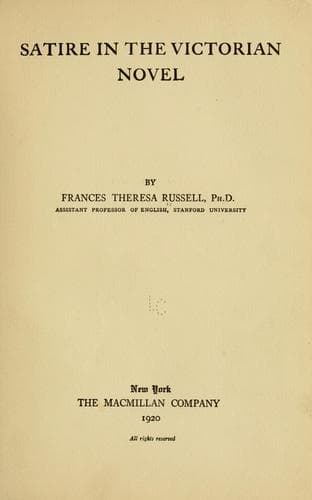
Satire in the Victorian novelRussell, Frances Theresa
History
Satire in the Victorian novel
Russell, Frances Theresa
English fiction -- 19th century -- History and criticism; Satire, English -- History and criticism; Thesis (Ph. D.)
Pessimism, to be consistent, would express itself in terms of tragedy.
Out of approximately one hundred Victorian novels of the realistic
type,--for romantic tragedy cannot be taken as an index of the
writer’s philosophy,--less than ten per cent can be classified as
tragic in outcome; and in none of these is the catastrophe inclusive,
overwhelming, or a perversion of justice. Of these the largest
proportion belongs to Eliot and Meredith, but _The Mill on the Floss_
is the solitary complete tragedy. _Rhoda Fleming_ and _Middlemarch_
are almost as truly tales of comic tragedians as _Romola_, _Richard
Feverel_, and _An Amazing Marriage_ are of tragic comedians. On the
other hand, tragedy of this mitigated sort is not inconsistent with
idealism, which in turn is the constructive side of criticism. While
it is too much, as Lytton reminds us in _Kenelm Chillingly_, to expect
both critical and constructive ability to be conspicuous in the same
individual, nevertheless the criticism which is content to note a
deflection from an ideal without even a tacit recognition of the
ideal deflected from, is mere childish fretting over the personally
irritating. Of this there is little in the nineteenth century. The
Victorians may have had some of the unpardonable disregard for reality
of which they have been accused,[407] but they never could be accused
of a disregard for ideality. None of the novelists, indeed, announced
an ecstatic premonition of some far-off, divine event toward which
the whole creation moves; but they would all have asserted, even if
under their breath,--_Eppur si muove_. This assertion is none the less
emphatic and possibly the more artistic, by being made indirectly,
through dramatic presentation of characters. Harley L’Estrange,
Egremont, Mr. Hale, Mrs. Brandon, Mark Tapley, Sidney Carton, Mr. Eden,
Jane Eyre, Alton Locke, Mr. Harding, Dinah Morris, Dorothea Brooke,
Austin Feverel, Vittoria, Beauchamp,--these all testify in their
various ways, by noble aspiration, generous self-effacement, sensitive
response to duty, devotion to principle, courage in daring and in
endurance, to the existence of a something in the human soul that is
stemming the tide of its selfishness, cowardice, and cruelty, and may
in time work out a salvation for the race.
Public-domain text, read in full here on John Shaqi.
Reviews
Reviews
No reviews yet
Be the first to share your thoughts on this work.
Elsewhere in the archive
Join the Discussion
Join the discussion
Sign in to leave a comment or review.
Sign InorCreate an account