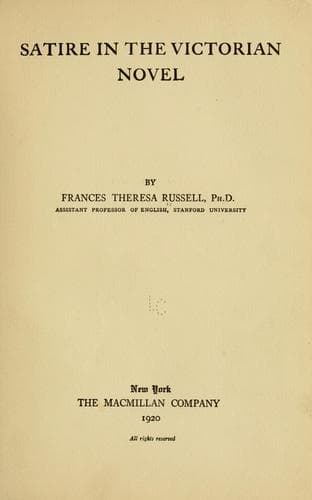
Satire in the Victorian novelRussell, Frances Theresa
History
Satire in the Victorian novel
Russell, Frances Theresa
English fiction -- 19th century -- History and criticism; Satire, English -- History and criticism; Thesis (Ph. D.)
Lytton shared the fondness of Dickens and Thackeray for pathos, but
none of them went further into the anatomy of melancholy than some such
comment as,--“Dig but deep enough, and under all earth runs water,
under all life runs grief.”[405]
* * * * *
Thackeray muses on the theme of aspiration in a whimsically pensive
vein. Between the questions and the exclamation of the following
excerpt are several instances of disappointment, related in his jocular
mock-sympathetic tone:[406]
“Succeeding? What is the great use of succeeding? Failing?
Where is the great harm? * * * Psha! These things appear
as naught--when Time passes--Time the consoler--Time the
anodyne--Time the grey calm satirist, whose sad smile seems to
say, Look, O man, at the vanity of the objects you pursue, and
of yourself who pursue them.”
In the essay _Of Adversity_ Bacon says,--“We see in needleworks and
embroideries it is more pleasing to have a lively work upon a sad and
solemn ground, than to have a dark and melancholy work upon a lightsome
ground.” In so far as this can be granted, and applied to the novel,
it would explain why George Eliot is more pleasing than Thackeray,
for that is just the difference between them. Athwart the brilliant
background of Vanity Fair fall the sinister shadows of the sordid
little Puppets of the Show,--“the bullies, the bucks, the knaves,
the quacks, the yokels, the tinselled dancers, the poor old rouged
tumblers, and the light-fingered folk operating on the pockets of the
rest.” Behind Hayslope, Raveloe, and Middlemarch, the Floss and the
Arno, hangs the curtain of Destiny, somber with pain, drudgery, sin and
its wages. Yet over it plays a light shed around the characters as they
appear upon the stage. It shines from Mrs. Poyser’s kitchen and Mr.
Irwine’s study, from the parlors of the sisters _née_ Dodson and the
Garth family, from Celia Chettam’s nursery, the bar at the Rainbow, and
the shops of Florence. Together these actors weave a pattern of mirth
and amusement,--the incorrigible human defiance of the ache of life and
the agony of death.
Dickens, (upon whose Hogarthian gloom Taine lays great stress),
Reade, and Kingsley are as critical of society in the larger sense as
Thackeray is in the smaller, and as Eliot and Trollope are of human
nature. Meredith has no illusions about any of these things, and Butler
comes nearer than any to an unqualified pessimism. But even he does
not attain it. They all escape through the avenue of satire, sometimes
reinforced by action,--both being efficacious means of getting
melancholia out of the system. Nowhere does Browning speak more as a
Britisher than when he declares rage to be the right thing in the main,
and acquiescence the vain and futile.
Public-domain text, read in full here on John Shaqi.
Reviews
Reviews
No reviews yet
Be the first to share your thoughts on this work.
Elsewhere in the archive
Join the Discussion
Join the discussion
Sign in to leave a comment or review.
Sign InorCreate an account