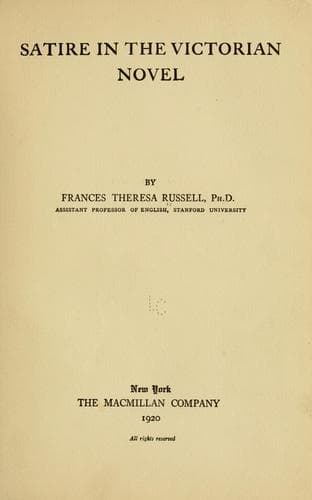
Satire in the Victorian novelRussell, Frances Theresa
History
Satire in the Victorian novel
Russell, Frances Theresa
English fiction -- 19th century -- History and criticism; Satire, English -- History and criticism; Thesis (Ph. D.)
That there are more of these fitful gleams and partial visions than of
an inclusive view of the cosmos, is not astonishing. The wide, clear
outlook requires not only an infinite radius but a lens of powerful
magnitude. To train a small telescope on a remote object achieves
nothing. None of the novelists evinces the cosmic perspective that
reports back in terms of a universe. That, indeed, is the function
of the seer,--poet, prophet, or philosopher. But if only these see
life in all its panoramic vastness, there are others who at least
splash at a ten-league canvas, and insist on having real figures
to draw from, whether saint or sinner. These have no use for the
trivial and frivolous, yet they know better than to scorn the small
and unpretentious. They delight in spaciousness, but are not enamored
with mere bulk or nebulous vagueness. Such are our satiric novelists
at their best, those among them ranking highest whose philosophical
humor is greatest in proportion to their love of the comic, and who are
granted sufficient wit to transmute their perception of the absurd into
effective expression.
The value of a sense of humor lies largely in a certain duality about
it, in that it springs from the intellectual side of one’s nature
and is reinforced by the emotional. It thus brings into play both of
the supplementary factors, and in so doing tests them both. To have
a sense of humor is an intellectual asset, but the enjoyment of it,
which is inseparable from its possession, is an emotional state. This
combination, as well as the order of procedure, affects the quality
of the resulting satire. The best satirists are those most fully
developed in head and heart, with the proviso that they keep the latter
subordinate to the former, by making reason the final tribunal, and
awarding the decision to intellectual judgment rather than emotional
prejudice.
Among our novelists the greatest in other things is greatest in this
also. The most generous endowment along both lines, and the nicest
balance between them is Meredith’s. With him are again associated Eliot
and Butler. Nor is it by accident that we find the lowest extreme
of the list still occupied by the same representatives. The test of
course is one of control. It is not that Reade, Kingsley, and Charlotte
Brontë are deficient in intellection. They do considerable thinking and
sometimes reach conclusions that are rational and true. But when truth
and rationality do dominate, it is by a happy good fortune rather than
the inevitability that marks the ratiocination of a capable mind. This
last cannot guarantee infallibility, to be sure, but the errors are
reduced to a minimum, and moreover left open to correction. This is
the case with Meredith, Eliot, and Butler, in whom a warm and sincere
emotion is directed by the light of reason.
Public-domain text, read in full here on John Shaqi.
Reviews
Reviews
No reviews yet
Be the first to share your thoughts on this work.
Elsewhere in the archive
Join the Discussion
Join the discussion
Sign in to leave a comment or review.
Sign InorCreate an account