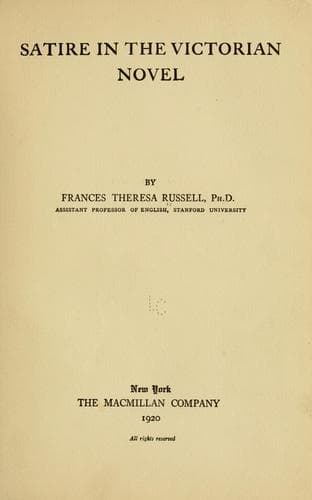
Satire in the Victorian novelRussell, Frances Theresa
History
Satire in the Victorian novel
Russell, Frances Theresa
English fiction -- 19th century -- History and criticism; Satire, English -- History and criticism; Thesis (Ph. D.)
It might seem at first sight that Butler ran more to head than heart;
but in this as in other things he was like Swift, having the faculty
of stating in cold logic what he had conceived in hot wrath. In such
a temperament the feelings are more likely to be turned against those
responsible for misery than toward the victims, thus producing a
negative effect, with the positive side left to our inference. The only
one whose work is entirely unemotional is Peacock, and even he waxes
warm over the exploitation of the helpless, and the crimes committed
in the name of Progress. Aside from this he shines with a hard mental
brilliance,--which, be it said, does not insure soundness of viewpoint,
as no one on the whole list can surpass him in prejudice and injustice.
George Eliot, admitted by all to have a better intellectual equipment
than any of her predecessors, admired above others by Meredith because
her fiction was “the fruit of a well-trained mind,” herself says, “Our
good depends on the quality and breadth of our emotion.”[415] And
again, “There is no escaping the fact that want of sympathy condemns
us to a corresponding stupidity.”[416] This realization that mental
inertness itself is the result of callous or defective emotion,
and that these two elements are not only inseparable but mutually
dependent, is one secret of the fine quality of her satire.[417]
It is the sheen on the surface of a deep current of sympathetic
comprehension. Never does she forget or cease to commiserate the great
predicament of the human race, condemned to make bricks without straw,
under a hard taskmaster, with little prospect of reward to encourage
perseverance or satisfy an outraged sense of justice. Yet she is able
to apply a few satiric goads,--not to the taskmaster, for he directs
from behind the veil and is not subject to human aspersions, nor to the
weak or the blundering, but to the shirkers, the selfish, and those who
demand more wage than a fair return for work done as well as possible
under the circumstances.
In 1902 Meredith wrote to his daughter-in-law:[418]
“You have a liking for little phrases; I send you three:--Love
is the renunciation of self. Passion is noble strength on fire.
Fortitude is the one thing for which we may pray, because
without it we are unable to bear the Truth.”
Public-domain text, read in full here on John Shaqi.
Reviews
Reviews
No reviews yet
Be the first to share your thoughts on this work.
Elsewhere in the archive
Join the Discussion
Join the discussion
Sign in to leave a comment or review.
Sign InorCreate an account