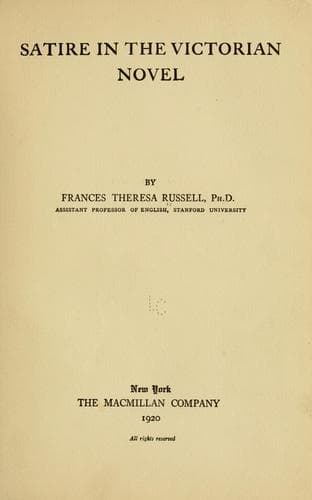
Satire in the Victorian novelRussell, Frances Theresa
History
Satire in the Victorian novel
Russell, Frances Theresa
English fiction -- 19th century -- History and criticism; Satire, English -- History and criticism; Thesis (Ph. D.)
“It may suit the Mr. Lyles of this age * * * to make the people
constantly and visibly comprehend that property is their
protector and their friend, but I question whether it will suit
the people themselves, unless they can make property understand
that it owes them something more definite than protection.”
At that time there was not much disposition to believe these ills
could be cured by legislation. On the contrary, the numerous satiric
hits at various governmental departments were aimed not at the general
_laissez faire_ policy of the State, but at its indifferent success in
the matters over which it had already assumed jurisdiction, and its
unwarranted encroachment into others. The reasoning seemed to be that
an institution which had been unfaithful and convicted of inertness,
graft, and stupidity in its limited operations would be unlikely to
be more alert, honest, and intelligent if its burdens were increased.
David Copperfield is shocked to learn from Mr. Spenlow the ways of
the law, and still more so at Mr. Spenlow’s coldness toward the idea
of reform.[445] Henry Little wades through and climbs over all sorts
of official obstacles until “he had done, in sixty days, what a true
inventor will do in twenty-four hours, whenever the various metallic
ages shall be succeeded by the age of reason.”[446] A prison inspector
is finally confronted with actual facts of a horrifying nature:[447]
“How unreal and idle appeared now the twenty years gone in tape
and circumlocution! Away went his life of shadows--his career of
watery polysyllables meandering through the great desert into
the Dead Sea.”
But more subtle and vital than all these errors,--the error indeed at
the root of them all,--is the failure of the State to utilize the fine
material placed at its disposal, potentially if not actually, in the
lives of noble and capable youth. No one before Lytton could have laid
at the door of society the wasted possibilities of a Godolphin. No
one before Meredith could have made the thwarted career of a Beauchamp
a pitiful satire on “his indifferent England,” who appeared, “with
a quiet derision that does not belie her amiable passivity, to have
reduced in Beauchamp’s career the boldest readiness for public action,
and some good stout efforts besides, to the flat result of an optically
discernible influence of our hero’s character in the domestic circle:
perhaps a faintly outlined circle or two beyond it.”[448]
In Society and the State all opposition is necessarily factional,
for none can stand entirely outside. This was true of the Church
also, during its undisputed supremacy, when to be excommunicated was
equivalent to being imprisoned or otherwise put outside the pale. But
by the sixteenth century Skelton could say in _Colyn Clout_,
Public-domain text, read in full here on John Shaqi.
Reviews
Reviews
No reviews yet
Be the first to share your thoughts on this work.
Elsewhere in the archive
Join the Discussion
Join the discussion
Sign in to leave a comment or review.
Sign InorCreate an account