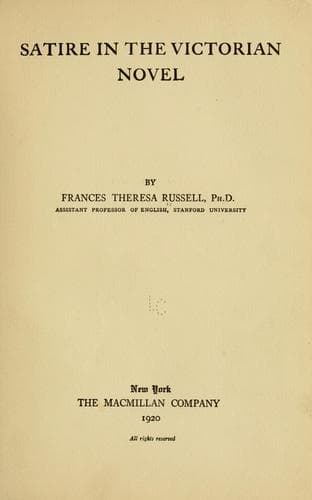
Satire in the Victorian novelRussell, Frances Theresa
History
Satire in the Victorian novel
Russell, Frances Theresa
English fiction -- 19th century -- History and criticism; Satire, English -- History and criticism; Thesis (Ph. D.)
This probing into causes is even more sweepingly operative in
the larger society of mankind and the body politic. The study of
economics and sociology inevitably has switched the old partisan
antagonism into a new opposition based more consciously on theories of
government,--still partisan, to be sure, but less on personal and more
on philosophical grounds. The new element this brings into political
satire is the effort to create a public sense of shame for official
incompetence, since in a democracy (and such, in some form or other,
is almost every modern State) the blame for this incompetence rests
ultimately on the public. Modern critics may echo Isaiah’s scornful
complaint of state officialdom,--“The ancient and the honorable
man, he is the head; and the prophet that teacheth lies, he is the
tail,”--but their remedy would lie not in increased reliance on a
theocracy but in a more adequate popular referendum. John Barton
concludes his impassioned tirade against mill-owners and capitalists
with the argument,--[440]
“Don’t think to come over me with th’ old tale, that the rich
know nothing of the trials of the poor; I say, if they don’t
know, they ought to know. We’re their slaves as long as we can
work; we pile up their fortunes with the sweat of our brows,
and yet we are to live as separate as Dives and Lazarus, with a
great gulf betwixt us: but I know who was best off then.”
On another occasion he adds this explanation,--[441]
“What we all feel sharpest is the want of inclination to try
and help the evils which come like blights at times over the
manufacturing places, while we see the masters can stop work and
not suffer.”
To this serious and personal grief Meredith responds, as it were, in
his more impersonal and ironic manner. Diana represents the view from a
position of equality, and the satire of one’s own class:[442]
“And charity is haunted, like everything we do. Only I say
with my whole strength--yes, I am sure, in spite of the men
professing that they are practical, the rich will not move
without a goad. I have and hold--you shall hunger and covet,
until you are strong enough to force my hand;--that’s the speech
of the wealthy. And they are Christians. In name. Well, I thank
heaven I’m at war with myself.’”
Kingsley is spurred by the subject to a bitter sarcasm:[443]
“The finest of us are animals, after all, and live by eating
and sleeping, and, taken as animals, not so badly off,
either--unless we happen to be Dorsetshire laborers--or
Spitalfield weavers--or colliery children--or marching
soldiers--or, I am afraid, one half of English souls this day.”
Nor is he lacking in a constructive outlook. In connection with a
fling at the “amusingly inconsistent, however well-meant scene in
_Coningsby_,” in which Disraeli illustrates his idea of a beneficent
aristocracy, he has one of his characters meditate that--[444]
Public-domain text, read in full here on John Shaqi.
Reviews
Reviews
No reviews yet
Be the first to share your thoughts on this work.
Elsewhere in the archive
Join the Discussion
Join the discussion
Sign in to leave a comment or review.
Sign InorCreate an account