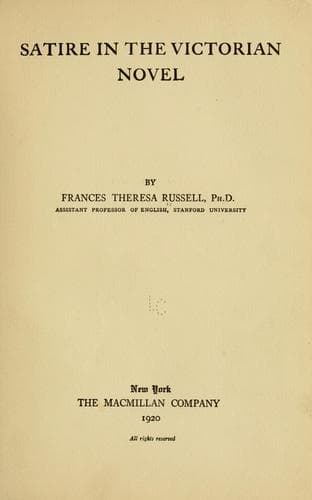
Satire in the Victorian novelRussell, Frances Theresa
History
Satire in the Victorian novel
Russell, Frances Theresa
English fiction -- 19th century -- History and criticism; Satire, English -- History and criticism; Thesis (Ph. D.)
The vague notion that a satirist is something disagreeable will of
course never quite be eradicated, at least not until people learn to
like being ridiculed and criticised. But in manner he is undeniably
growing less disagreeable than has been his wont. Another reason for
this, in addition to the changes already noted, is the increased
activity of that reflexive sense of humor which operates as an
antitoxin to the vanity inherent in all critics. A wholesome fear of
being absurd serves to reduce one’s chances of being that rich anomaly,
a ridiculous satirist. The modern satirist may possess a mind conscious
to itself of right and a conviction that he has a mission to perform.
But he is more prone to conceal or even disclaim these things than
to advertise them. Even Fielding did not proclaim, as he might have
done, that he first adventured. Peacock trusted to his readers to
discover that fools being his theme, satire must be his song. Since
his time, satire, while questioning all things with a new penetration,
has succeeded in taking on an air of unconcern and in realizing that
neither promises nor apologies are necessary. Post-Byronic satire
seldom vaunts itself, and, however superior it may feel, it pretends
that it is not puffed up. A historian describes the change that takes
place between the Age of Elizabeth, when satire “was the pastime of
very young men, who ‘railed on Lady Fortune in good set terms,’” and
the Commonwealth, when the combatants “left Nature and Fortune with
their withers unwrung, and aimed at the joints in the harness of their
enemies.”[454] To the Victorians, satire was neither a pastime nor a
matter for deadly earnestness. Armored antagonists had gone out of
fashion; and Lady Fortune was left to the metaphysicians.
It is, indeed, a matter of curious interest that one object of
satire, life itself, which had drawn fire occasionally all the
way from Aristophanes to Byron, should have been neglected by the
Victorians,--though the neglect may be accounted for by their interest
in the concrete and their generally optimistic outlook. On the other
hand, one of the most philosophic and least optimistic of them
devotes several bow-shots to a sort of counter attack, against those
who consider the universe a fit subject for satire. The Prelude to
_Middlemarch_ identifies the heroine as one of those unfortunate
women of deep souls and shallow circumstances, “who found for
themselves no epic life wherein there was a constant unfolding of
far-resonant action.” To this the comment is added:[455]
“Some have felt that these blundering lives are due to the
inconvenient indefiniteness with which the Supreme Power has
fashioned the natures of women: if there were one level of
feminine incompetence as strict as the ability to count three
and no more, the social lot of women might be treated with
scientific certitude.”
Public-domain text, read in full here on John Shaqi.
Reviews
Reviews
No reviews yet
Be the first to share your thoughts on this work.
Elsewhere in the archive
Join the Discussion
Join the discussion
Sign in to leave a comment or review.
Sign InorCreate an account