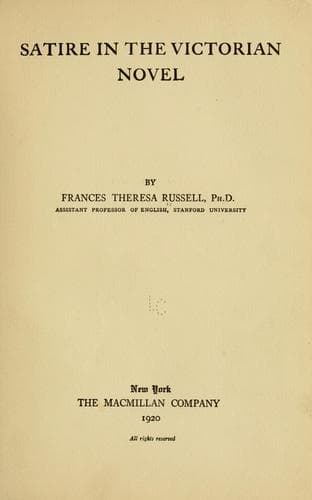
Satire in the Victorian novelRussell, Frances Theresa
History
Satire in the Victorian novel
Russell, Frances Theresa
English fiction -- 19th century -- History and criticism; Satire, English -- History and criticism; Thesis (Ph. D.)
But though a knowledge of mortal psychology does have a tendency to
take the starch out of satire, it does not thereby destroy the fabric
but only leaves it the more diaphanous. It no longer rustles and
crackles but flows instead with the sweeter liquefaction of Julia’s
silk. This gentle diffusion of her presence is a less obtrusive rôle
than satire has hitherto enjoyed but is none the less essential, and
in any case it is all that can be allowed by a scientific, democratic
society, too well informed to deal only with surfaces, too preoccupied
with its own business and desires, such as they are, to worry much
about the fiasco others make of theirs, too polite to scold even with
wit, and too truly humorous to tolerate the superior pose.
In proportion however, as the individual is spared, the burden of
responsibility is shifted to the collected shoulders of the society he
has bound himself into. Logically, of course, the collection is no more
guilty than its constituents, but it has the advantage of being quite
as vulnerable and capable of improvement, and yet not endowed with
personal feelings to be wounded or personal ability to retaliate.
So far as there is a definite Victorian contribution to the garner of
satire, it lies in this democratization of objects and rationalization
of methods. How great an impulse the Victorians gave to the era of
agnosticism and revaluation of all ideals whose inception so troubled
the waters of their reluctant souls, we never can know. What Shaw,
Ibsen, Maeterlinck, Rostand, even Wells and Nietzsche, would have been
without Peacock, Disraeli, Carlyle, Dickens, George Eliot, Huxley,
Meredith, and Butler, is a question that admits of a wide solution.
But it is assuredly as foolish to disdain the offerings of a past
generation, however erring, ignorant, and prejudiced we may consider it
in the light of our own emancipation and advancement, as to suppose
that we shall count for more than our due modicum in the centuries to
come.
However that may be, we have as yet invented nothing to surpass the
general Victorian satiric philosophy,--that the wisest reaction to
life is a high seriousness graced with humor, and the most acceptable
attitude toward one’s fellow creatures is a compassionate comprehension
of our common tragedy, redeemed from emotionalism by an ironic
appreciation of the human comedy.
BIBLIOGRAPHICAL NOTE
Since the bibliography of this subject is necessarily too extensive
to be cited in full, the following list includes only those volumes
of especial importance, particularly in the field of satire. For
convenience the list is classified according to the main divisions of
the material.
I
ON SATIRE
Alden, R. M.: _The Rise of Formal Satire in England under
Classical Influence_. Univ. of Penn. Pub., Phil. Series, VII,
2, 1902.
Public-domain text, read in full here on John Shaqi.
Reviews
Reviews
No reviews yet
Be the first to share your thoughts on this work.
Elsewhere in the archive
Join the Discussion
Join the discussion
Sign in to leave a comment or review.
Sign InorCreate an account