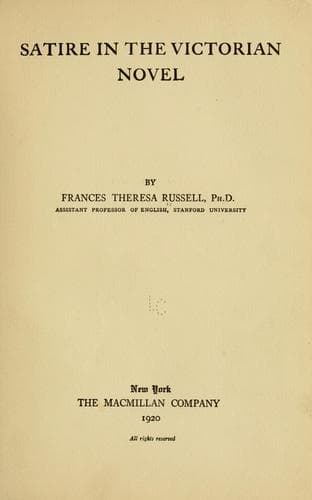
Satire in the Victorian novelRussell, Frances Theresa
History
Satire in the Victorian novel
Russell, Frances Theresa
English fiction -- 19th century -- History and criticism; Satire, English -- History and criticism; Thesis (Ph. D.)
It may be that as we reason more we laugh less; and that brings the
question whether it were wiser to check the reasoning or quench the
laughter. Since, however, laughter is likely to improve in quality as
it diminishes in quantity, we may be content to abjure the witticism
at which “the fool lifteth up his voice with laughter,” and substitute
the reflective wit over which “the clever man will scarce smile
quietly.” Such was the mild aspiration of the humorous Victorians; but
though mild, the spirit was ubiquitous. It gave tone to the pessimism
of Thompson and temper to the optimism of Stevenson; it colored
darkly the defiant pages of Carlyle and tinged lightly the protesting
paragraphs of Arnold; it lent an edge to the sentiment of Tennyson and
humanized the philosophy of Browning. It even dignified the comicality
of _Punch_, for Douglas Jerrold, at least, was far from being
an irresponsible jester. His gruesome _Dish of Glory_, with its
ironical advice to the French to eat the Algerians as fast as they
conquer them, will bear comparison with _The Modest Proposal_.
The dedication of volume eight also illustrates the new effect of
self-turned irony:
“As young Aurora, with her blaze of light,
Into the shade throws all the pride of night,
And pales presumptuous stars, who vainly think
That every eye is on them as they blink:
So _Punch_, the light and glory of the time,
His wit and wisdom brilliant as sublime,
Scares into shades Cant’s hypocritic throng,
Abashes Folly, and exposes wrong.”
This may sound like an echo from the Elizabethans and the Augustans;
but the difference wherewith the Victorians wear their rue is as
important as it is subtle. The two great influences of their time,
Science and Democracy, operating upon their life and literature,
made them at once sensitive to the reasons for man’s shortcomings,
and sensible of the absurd position of the avowed castigator--who,
moreover, by his very situation as a sharp-shooter renders himself in
turn the more conspicuous target.
Man’s record here below gives little cause, it is true, for
congratulation; so discounted are his astonishing successes by
his disheartening, hopeless failures. Colossal in blunder as in
achievement, stupendous in fanaticism as in imagination, nevertheless
he may maintain, on the authority of a deterministic philosophy, that
he has literally done the best he could. His very faculty of deception
is often but an adoption of that protective coloring recognized as
one of Nature’s most admirable devices. The human race is indeed
provocative, but who that understands can have the heart to yield
to the provocation? Even the most accomplished satirist of his time
concluded that he would stick to sober philosophy,--[469]
“And irony and satire off me throw.
They crack a childish whip, drive puny herds,
Where numbers crave their sustenance in words.”
Public-domain text, read in full here on John Shaqi.
Reviews
Reviews
No reviews yet
Be the first to share your thoughts on this work.
Elsewhere in the archive
Join the Discussion
Join the discussion
Sign in to leave a comment or review.
Sign InorCreate an account