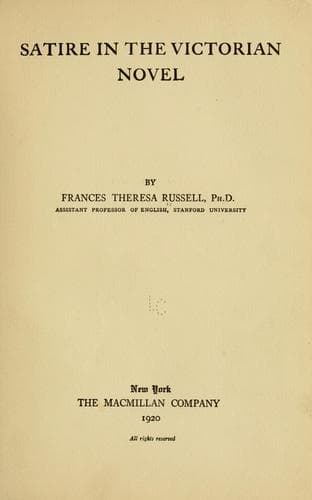
Satire in the Victorian novelRussell, Frances Theresa
History
Satire in the Victorian novel
Russell, Frances Theresa
English fiction -- 19th century -- History and criticism; Satire, English -- History and criticism; Thesis (Ph. D.)
We may, however, see satire as opposition, and moreover opposition to
vice and folly, and still be taking for granted that which demands more
probing. For even if it were so simple a crusade as that, no crusade is
as simple as it looks, and this one is particularly open to suspicion.
It is therefore not wholly superfluous to ask why vice and folly are
the favorite satiric goals. Psychologically it would be sufficient to
say that it is because anything a man disapproves of naturally seems to
him foolish if not actually vicious. But socialized man cannot admit
that his reaction to anything is based on mere temperamental prejudice.
Condemnation of vice and folly is of course its own justification, and
humor is its own reward. Unfortunately, however, humorous condemnation
is not always applicable to these offenders against taste and morality.
Folly is sometimes too artless to be censured, and vice is often too
serious to be ridiculed. Evidently then, yet another solution is
needed, a least common denominator that will go into both, even if it
does leave a remainder.
Now it happens that a body of explicit testimony, substantiated by
a review of satiric practice, does indicate the existence of this
unifying bond, this thing which, when present, makes both vice and
folly criticizably absurd; and its generic name is deception.
This fraudulent family has two main branches: the intentional type,
including hypocrisy and humbug; and the unconscious, represented
by sentimentality and other forms of self-befoolment; besides a
half-conscious variety, whence come vanity, snobbishness, superstition,
vulgarity, and other children of perverted ambition and false
reasoning. All these give plenty of scope to the satirist, even when we
subtract some possibilities by the important qualification that not all
that deceives is ludicrous; deception being sometimes too innocent and
even altruistic and sometimes too tragic and cruel.[39]
According to this test, anything which assumes a virtue when it has it
not may draw satiric fire. It is the assumption itself, the pose, that
furnishes the shining mark loved by the satirist.
On this point we again have Horatian testimony:[40]
“_Quid, cum est Lucilius ausus_
_Primus in hunc operis componere carmina morem,_
_Detrahere et pellem, nitidus qua quisque per ora_
_Cederet, introrsum turpis_, * * *”
Gascoigne[41] symbolised by his steel glass that which reflected the
beholders as they were, not flattered as by the plated mirror; and said
his effort was to “sing a verse to make them see themselves.” He also
identified the root of all evil with hypocrisy;--“So that they seem,
and covet not to be.”
Cervantes[42] spoke of his “Herculean labor” as being “nothing more nor
less than to banish mediocrity from the realm of Spanish poetry, and to
sweep from its sacred precincts, which had become as foul as an Augean
stable, all shams, lies, hypocrisies, and vulgar baseness whatsoever.”
Public-domain text, read in full here on John Shaqi.
Reviews
Reviews
No reviews yet
Be the first to share your thoughts on this work.
Join the Discussion
Join the discussion
Sign in to leave a comment or review.
Sign InorCreate an account