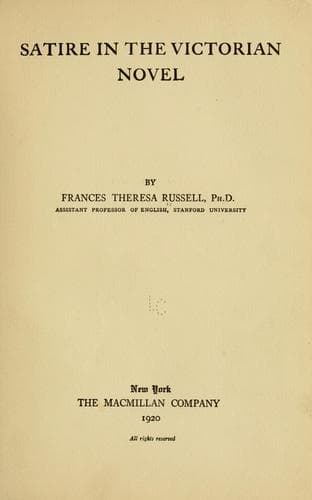
Satire in the Victorian novelRussell, Frances Theresa
History
Satire in the Victorian novel
Russell, Frances Theresa
English fiction -- 19th century -- History and criticism; Satire, English -- History and criticism; Thesis (Ph. D.)
The connection between these two pairs of subdivisions is evident;
hypocrisy belonging on the whole to the vicious branch, and
sentimentality, to the foolish.
[40] _Satires_, II, 1.
[41] _The Steele Glas._
[42] Preface to _The Journey to Parnassus_. Gibson’s translation.
[43] Fielding: _Tom Jones_.
The phrase omitted from the Dryden citation above is, “where the very
name of satire is formidable to those persons, who would appear to the
world what they are not in themselves:”
[44] Raleigh: _The English Novel_.
[45] _Hist. of Eng. Lit._: on Dickens.
[46] _Imaginary Conversations_: Lucian and Timotheus.
Timotheus, exultant over the _Dialogues_, remarks that “Nothing can
be so gratifying and satisfactory to a rightly disposed mind, as the
subversion of imposture by the force of ridicule.” Disappointed,
however, in his assumption that Lucian is now ready to embrace the
true faith, which turns out to be a _non sequitur_, he accuses the
inflexible pagan of sacrilege, ready to turn into ridicule the true
and the holy. To which Lucian in turn replies “In other words, to turn
myself into a fool. He who brings ridicule to bear against Truth, finds
in his hands a blade without a hilt. The most sparkling and pointed
flame of wit flickers and expires against the incombustible walls of
her sanctuary.”
Lucian himself, in _The Angler_, declares it his business to hate
quacks, jugglery, lies, and conceit.
[47] _Essay on Comedy._
[48] _Laughter_, 174.
[49] _Byron as a Satirist_, 180.
[50] _Political Satire in English Poetry_, 240.
In his _Temper of the Seventeenth Century in English Literature_,
Wendell contributes another link to the chain of evidence:
“Sincere or not, satire is essentially a kind of writing which pretends
to unmask pretense.”
[51] Hazlett, in his essay on _Wit and Humour_, remarks that “it has
appeared that the detection and exposure of difference, particularly
where this implies nice and subtle observation, as in discriminating
between pretence and practice, between appearance and reality, is
common to wit and satire with judgment and reasoning.”
[52] Meredith characterises the chase of Folly by the Comic Spirit as
conducted “with the springing delight of hawk over heron, hound after
fox.”
[53] _Satires_: I, IV, 78 ff.
[54] _Universal Passion._
[55] _Charity._
[56] _Literary Theory and Criticism._ The Poetry of Pope.
[57] _Imag. Conv._ Lucian to Timotheus.
[58] _Arist. Apol._
[59] In spite of Cowper’s and Byron’s assertions to the contrary.
[60]
“All zeal for a reform that gives offense
To peace and charity, is mere pretense;
A bold remark; but which, if well applied,
Would humble many a tow’ring poet’s pride.”
(_Charity._)
[61] _Sea Dreams._
[62] _Collected Essays_, I, 187.
[63] _Post Liminium._
[64] Preface to _Headlong Hall_, in the Aldine edition of Peacock, 40.
In his _Essay on Comedy_, Meredith goes beyond mere absence of hate:
Public-domain text, read in full here on John Shaqi.
Reviews
Reviews
No reviews yet
Be the first to share your thoughts on this work.
Elsewhere in the archive
Join the Discussion
Join the discussion
Sign in to leave a comment or review.
Sign InorCreate an account