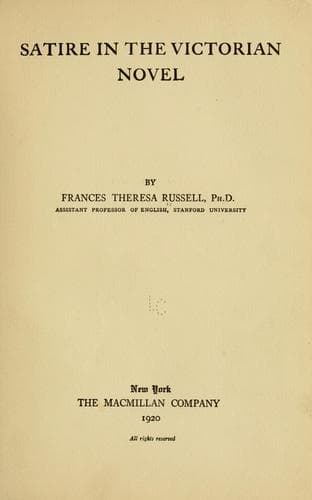
Satire in the Victorian novelRussell, Frances Theresa
History
Satire in the Victorian novel
Russell, Frances Theresa
English fiction -- 19th century -- History and criticism; Satire, English -- History and criticism; Thesis (Ph. D.)
“You may estimate your capacity for comic perception by being able to
detect the ridicule of them you love, without loving them the less; and
more by being able to see yourself somewhat ridiculous in dear eyes,
and accepting the correction their image of you proposes,” 72.
It is true that on the next page he differentiates,--“If you detect the
ridicule, and your kindliness is chilled by it, you are slipping into
the grasp of satire.” But he is evidently using satire in the older,
narrower sense.
[65] John Brown’s _Essay on Satire_.
[66] _Spectator_, 209. L.
[67] Browning: _Aris. Apol._ Cf. Fielding, _Tom Jones_, VI, 357, for a
similar distinction.
[68] Cf. Brown’s _Essay on Satire_ for scorn of Shaftesbury’s idea that
ridicule is the test of truth; refuted ironically in the lines,--
“Deride our weak forefathers’ musty rule,
Who _therefore_ smil’d, _because_ they saw a fool;
Sublimer logic now adorns our isle,
We _therefore_ see a fool, _because_ we smile.”
He concludes that wit is safe only when rationalized:
“_Then_ mirth may urge, when reason can explore,
_This_ point the way, _that_ waft us to the shore.”
(Carlyle expresses a similar opinion in his essay on Voltaire.)
[69] Heinsius, in his _Dissertations on Horace_. A conception drawn
perhaps from the Aristotelian “purging of our passions” through tragedy.
[70] _Rise of Formal Satire in England._ 49.
[71] Leslie Stephen: _George Eliot_, 67–68.
[72] Thorndike, _English Literature_ in _Lectures on Literature_, 268–9.
[73] This theoretically includes only the novel, though the term is
used in the widest sense. In the cases of Thackeray, Dickens, Eliot,
and Meredith, the line is rather hard to draw between the novel and
sketches, tales, short stories, and burlesques. Peacock, Lytton,
Disraeli, and Butler force us to make the limits of the novel decidedly
flexible.
[74] If it were desirable to eliminate the thirteenth chair, it
might be done in a number of ways. Peacock might be ruled out as a
contemporary of the earlier generation, as _Gryll Grange_ is all that
carries him over. Butler on the other hand belongs to the later, except
that _Erewhon_ appeared in the year of _Middlemarch_. As a satirist,
Brontë is so near the edge of the circle that her inclusion at all is
questionable. Since it happens, however, that the year of her death
coincides with that of Reade’s first novel, we might fancy her yielding
a place to him, so that there were never more than twelve at one time.
[75] _English Humorists_; _Swift_, 2.
Cf. Kingsley: “One cannot laugh heartily at a man if one has not a
lurking love for him.” _Two Years Ago_, 143.
And Meredith: “And to love Comedy you must know the real world, and
know men and women well enough not to expect too much of them, though
you may still hope for good.” _Essay on Comedy_, 40. Also: “You share
the sublime of wrath, that would not have hurt the foolish, but merely
demonstrate their foolishness.” Ibid. 85.
Public-domain text, read in full here on John Shaqi.
Reviews
Reviews
No reviews yet
Be the first to share your thoughts on this work.
Elsewhere in the archive
Join the Discussion
Join the discussion
Sign in to leave a comment or review.
Sign InorCreate an account