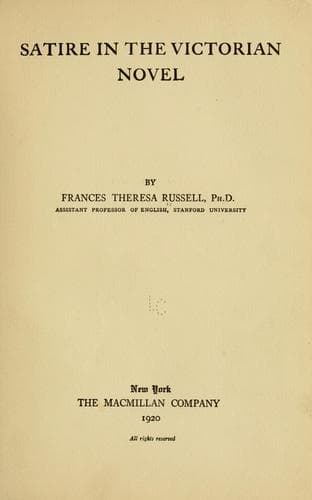
Satire in the Victorian novelRussell, Frances Theresa
History
Satire in the Victorian novel
Russell, Frances Theresa
English fiction -- 19th century -- History and criticism; Satire, English -- History and criticism; Thesis (Ph. D.)
[94] “He has knowledge, wit, humour, technical skill, cleverness in
abundance, some genius, he is a keen observer, a caustic critic. What
he lacks is humanity, just that which is the essence of the greatness
of the great humourists--Cervantes, Rabelais, Shakespeare.” Walker:
_Lit. of the Victorian Era_, 618. (He explains that humanity in work is
meant, not of character.)
[95] “But because he laughed without responsibility he belongs less
with the writers of power than with those of whom laughter has exacted
a great, as of all laughter exacts a certain, penalty.” Van Doren,
_Life of Peacock_, 281.
(One could wish the nature of this “penalty” had been elucidated a bit,
instead of being entirely taken for granted. In any case, it must be
largely subjective, and therefore a thing which exists only by being
felt.)
[96] The phrases are Van Doren’s and Walker’s respectively. Cf. Garnett:
“It cannot be said that the satire of _Gryll Grange_ is very
Archilochian. The author has lost the power of raising a laugh at
the objects of his dislike, and merely assails them with a genial
pugnacity, so open, honest, and hearty as inevitably to conciliate a
certain measure of sympathy.” _Introduction._
[97] With _The First Canterbury Settlement_, in 1863.
[98] The coincidence that gave the public _The Coming Race_ in 1871,
and _Erewhon_ in 1872 brought the charge of a possible plagiarism in
the latter. If the absurd notion that Butler needed any light borrowed
from Lytton, is worth expelling, Butler’s own candid statement about it
should be sufficient for the purpose.
[99] Cannan says of _Erewhon_, “Few good books have so many faults,
and yet it remains the one enduring satire of the nineteenth century.”
_Samuel Butler_, 32.
(Whether the _of_ means _directed against_ or _produced by_, the
verdict is undoubtedly valid.)
[100] One’s astonishment that it was Meredith who had the honor of
rejecting the manuscript of _Erewhon_, submitted to Chapman and Hall,
is exceeded only by the astonishment at the reason given,--that it was
a philosophical treatise, not likely to interest the general public.
One would hardly accuse this critic of a conservative reluctance to
expose the public to iconoclastic bacilli, though he had not yet become
the author of _Beauchamp’s Career_, nor would one suppose his “public”
to be composed entirely of tired business men and sentimental school
girls. There remain the two cruxes in the history of satire: failure
of the satirist Thackeray to appreciate the satirist Swift, and of the
satirist Meredith to appreciate the satirist Butler. If they prove
anything it is the diversity among satirists.
[101] Harris: _Samuel Butler, Author of Erewhon_, 13.
Cf. Chesterton’s whimsical remark that “the best definition of the
Victorian Age is that Francis Thompson stood outside it.”
[102] _The Coming Race_, 47.
Public-domain text, read in full here on John Shaqi.
Reviews
Reviews
No reviews yet
Be the first to share your thoughts on this work.
Elsewhere in the archive
Join the Discussion
Join the discussion
Sign in to leave a comment or review.
Sign InorCreate an account