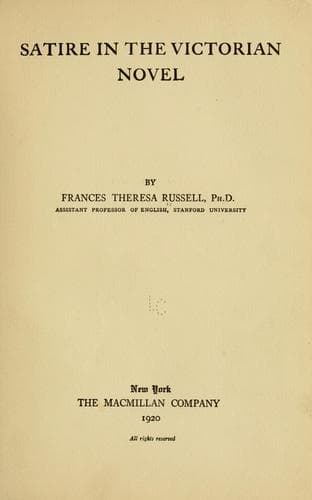
Satire in the Victorian novelRussell, Frances Theresa
History
Satire in the Victorian novel
Russell, Frances Theresa
English fiction -- 19th century -- History and criticism; Satire, English -- History and criticism; Thesis (Ph. D.)
[103] Women were the wooers and choosers in this feministic community,
but the problem of feminism was apparently solved by the practice of
voluntary relinquishment of wings, by the feminine wearers, after
marriage, and a strict devotion to the domestic life.
[104] “And where a society attains to a moral standard in which there
are no crimes and no sorrows from which tragedy can extract its aliment
of pity and sorrow, no salient vices or follies on which comedy can
lavish its mirthful satire, it has lost its chance of producing a
Shakespeare, a Molière, or a Mrs. Beecher Stowe.” _The Coming Race_,
230.
[105] After the manner of Defoe’s _Turkish Merchant: the Conduct of
Christians Made the Sport of Infidels_, and others of this type.
[106] _Popanilla_, 380. The ensuing debate is made the peg for some
vivacious burlesque on Parliamentary speeches.
[107] _Ibid._, 385.
[108] _Popanilla_, 394.
[109] _Ibid._, 459. The whole is in ridicule of Utilitarianism.
[110] _Ixion_, 272.
[111] A prominent feature of this is a white ass (the Public) which the
prime minister leads by the nose.
[112] The laborers.
[113] These two are alike in their handling of sparkling dialogue.
[114] Walker’s dictum (_Victorian Literature_, 700) that “Good
burlesque is impossible except through sound criticism,” is an instance
of the dangerous half truth. The sounder the criticism the better the
burlesque, to be sure, but only as _criticism_: as _burlesque_ it may
be highly successful in spite of some critical unsoundness. Indeed, it
must necessarily contain the element of injustice that inheres in all
exaggeration,--the very foundation of burlesque and caricature.
Moreover, Walker’s conception of the burlesque is indicated when he
calls _Rebecca and Rowena_ “perhaps the best burlesque ever penned.”
As a matter of fact, it is not only far from that preëminence, but it
is in form actually less of a burlesque than most of the others under
consideration.
[115]
“Heroes and gods make other poems fine;
Plain Satire calls for _sense_ in every line.”
Young: _Universal Passion_.
[116] In one of Lytton’s first volumes is an observation interesting as
perhaps the germ from which the plan of _The Coming Race_ was developed.
Vincent, the philosopher of the story, remarks. (_Pelham_, 57):
“There are few better satires on a civilized country than the
observations of visitors less polished; while, on the contrary,
the civilized traveller, in describing the manners of the American
barbarians, instead of conveying ridicule upon the visited, points the
sarcasm on the visitor; and Tacitus could not have thought of a finer
or nobler satire on the Roman luxuries than that insinuated by his
treatise on the German simplicity.”
[117] Mill: _Disraeli, the Author, Orator, and Statesman_, 20.
Public-domain text, read in full here on John Shaqi.
Reviews
Reviews
No reviews yet
Be the first to share your thoughts on this work.
Elsewhere in the archive
Join the Discussion
Join the discussion
Sign in to leave a comment or review.
Sign InorCreate an account