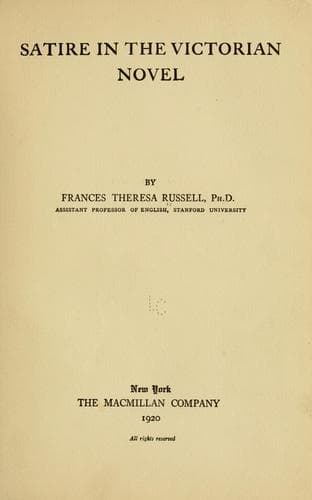
Satire in the Victorian novelRussell, Frances Theresa
History
Satire in the Victorian novel
Russell, Frances Theresa
English fiction -- 19th century -- History and criticism; Satire, English -- History and criticism; Thesis (Ph. D.)
Cf. _Evan Harrington_, 208, for the muddled state of a young woman’s
mind, only to be penetrated by “that zigzag process of inquiry
conducted by following her actions, for she can tell you nothing, and
if she does not want to know a particular matter, it must be a strong
beam from the central system of facts that shall penetrate her.”
[140] _The Egoist_, 156.
[141] _The Egoist_, 5.
[142] _The Egoist_, 5.
[143] _Our Mutual Friend_, I, 166.
[144] Trollope: _Barchester Towers_, 299.
[145] _The Egoist_, 4. The “her” refers to Comedy.
[146] _Barchester Towers_, 472–3.
[147] _Last Chronicles of Barset._
[148] Book II, Chapter I.
[149] Vol. I, 78–9.
[150] Lytton’s _Kenelm Chillingly_, 1873, and Meredith’s _Beauchamp’s
Career_, 1876.
[151] Lytton’s _Kenelm Chillingly_, 38.
[152] _Ibid._, 39. An echo from _The Coming Race_, published two years
earlier.
[153] _Ibid._, 40.
[154] _Ibid._, 90. Later he imagines a hypothetical contribution
to _The Londoner_, bringing “that highly intellectual journal into
discredit by a feeble attempt at a good-natured criticism or a generous
sentiment.” 161.
Kenelm grows into some likeness to his old tutor Welby, an unpedantic,
versatile scholar, who belonged to “the school of Eclectical
Christology.” The Rev. John Chillingly, for instance, did not perceive
Welby’s realism, for the latter listened to idealistic eulogies without
contradicting them; having “grown too indolent to be combative in
conversation, and only as a critic betrayed such pugnacity as remained
to him by the polished cruelty of sarcasm.” 34.
[155] _Beauchamp’s Career_, 167.
[156] _Shirley_, II, 90.
[157] _Ibid._, II, 351.
[158] _Ibid._, II, 250.
[159] It is not in a novel but the shortest of his Short Stories that
Meredith has presented to us his truly wittiest character, shown with
the brief but startling distinctness of a flash-light. Nowhere is there
a more perfect embodiment of the satiric spirit than Lady Camper.
It required a malicious imagination to produce the cartoons of the
City of Wilsonople, and to use them with such wicked effectiveness.
Yet this Limb of Satan was maleficent only to bless, ultimately. The
fine military figure upon which she turned the shaft of illumination
is equally perfect as the incarnate satirizible; not a sinner, not
a villain, but a complacent, fatuous, selfish gentleman, “open to
exposure in his little whims, foibles, tricks, incompetencies,” but
capable of an improvement that amounted to regeneration.
“Well, General,” his teleological tormentor finally explains, “you
were fond of thinking of yourself, and I thought I would assist you.
I gave you plenty of subject-matter. I will not say I meant to work a
homœopathic cure.”
Public-domain text, read in full here on John Shaqi.
Reviews
Reviews
No reviews yet
Be the first to share your thoughts on this work.
Elsewhere in the archive
Join the Discussion
Join the discussion
Sign in to leave a comment or review.
Sign InorCreate an account