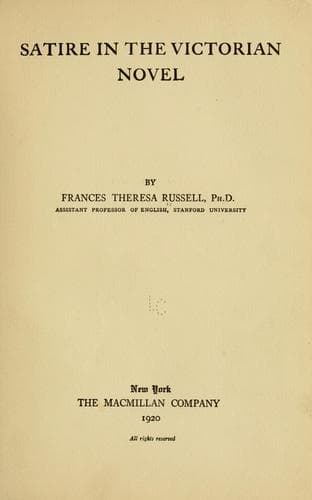
Satire in the Victorian novelRussell, Frances Theresa
History
Satire in the Victorian novel
Russell, Frances Theresa
English fiction -- 19th century -- History and criticism; Satire, English -- History and criticism; Thesis (Ph. D.)
She further admonishes him that the triumph is his rather than hers,
if he cares to make the most of it. “Your fault has been to quit
active service, General, and love your ease too well * * * You are
ten times the man in exercise. Why, do you mean to tell me that you
would have cared for those drawings of mine when marching?” Idleness,
moreover, is a first aid to vanity. “You would not have cared one bit
for a caricature,” Lady Camper continues, “if you had not nursed the
absurd idea of being one of our conquerors.” His final salvation, she
concludes, was his sensitiveness to ridicule.
[160] _Last Chronicles of Barset_, 97.
[161] _Ibid._, 175.
[162] _Framley Parsonage_, 259.
[163] _Framley Parsonage_, 264.
[164] _Ibid._, 266.
[165] On dramatic irony, see _American Philological Association
Transactions_, 1917, for summary of an interesting unpublished paper
read before the Society by Dr. J. S. P. Tatlock.
[166] As advised by John Brown in his _Essay on Satire_:
“The Muse’s charms resistless then assail,
When wrapt in _irony’s_ transparent veil;
* * * * *
Then be your lines with sharp encomiums grac’d;
Style _Clodius_ honorable, _Busa_ chaste.”
And not long before this, Dryden had been saying: “How easy it is to
call rogue and villain, and that wittily! But how hard to make a man
appear a fool, a blockhead, or a knave, without using any of these
opprobrious terms! * * * Neither is it true that this fineness of
raillery is offensive. A witty man is tickled while he is hurt in this
manner, and a fool feels it not.” _Essay on Satire_, 98.
[167] Stephen: _Hours in a Library_, Second Series. 347.
Another critic of another novelist makes the point by a vivid
illustration:
“A rabbit fondling its own harmless face affords no matter of amusement
to another rabbit, and Miss Austen has had many readers who have
perused her works without a smile.” Raleigh: _The English Novel_, 253.
[168] _Life and Letters_, I, 207.
[169] _The Renaissance in Italy_, V, 8.
[170] _Irony, Living Age_, 259: 250.
[171] _A Second Century Satirist_, 187. A translation by W. D. Sheldon.
[172] _Adventures of an Atom_, II, 121.
[173] Randolph Bourne: _The Life of Irony_. _Atlantic_, III, 357.
[174] Corbyn Morris, in _An Essay towards fixing the True Standards of
Wit, Humour, Raillery, Satire, and Ridicule_.
[175] _The English Novel_, 195.
[176] _Wives and Daughters_, 397.
[177] _Shirley_, I, 236.
[178] _Alton Locke_, 58.
[179] _Yeast_, 158.
[180] _Pelham_, 9.
[181] _Crochet Castle_, 21.
[182] _Kenelm Chillingly_, 25.
[183] _Coming Race_, 43.
Public-domain text, read in full here on John Shaqi.
Reviews
Reviews
No reviews yet
Be the first to share your thoughts on this work.
Elsewhere in the archive
Join the Discussion
Join the discussion
Sign in to leave a comment or review.
Sign InorCreate an account