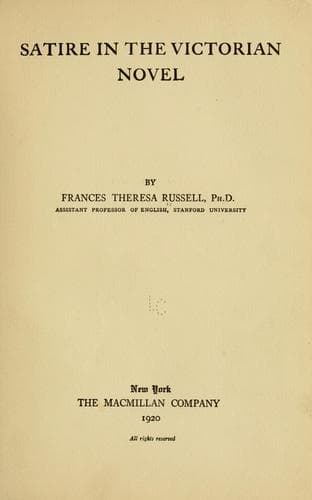
Satire in the Victorian novelRussell, Frances Theresa
History
Satire in the Victorian novel
Russell, Frances Theresa
English fiction -- 19th century -- History and criticism; Satire, English -- History and criticism; Thesis (Ph. D.)
[406] _Sketches and Travels_: in London, 268. Cf. Taine’s comment that
Thackeray “does as a novelist what Hobbes does as a philosopher. Almost
everywhere, when he describes fine sentiments, he derives them from an
ugly source.” _Hist. of Eng. Lit._, IV, 188.
[407] “Of this national disease, this indifference to reality, the main
bulk of nineteenth century English fiction has died already or must
soon be dead.” Gosse: _Eng. Lit. in the Nineteenth Cent._ 221.
[408] _Letters_, I, 156.
[409] _Godolphin_, 106–7. Cf. _Pelham_, 106 ff. for a long discussion
of the novel.
[410] _Autobiography_, 206. But on another page he describes the sense
of intimate reality he had of his beloved Barsetshire, and how vivid
was the mental map he had made of it.
[411] _Diana of the Crossways_, 275.
[412] _The Egoist_, 2.
[413] _Adam Bede_, I, 268.
[414] _History of English Literature_, V, 140.
[415] _Middlemarch_, II, 275. In this story also occurs the exquisite
passage on the theme of the second citation above: “If we had a keen
feeling and vision of all ordinary human life, it would be like seeing
the grass grow and hearing the squirrel’s heart beat, and we should die
of that roar which lies on the other side of silence. As it is, the
quickest of us walk about well wadded with stupidity.”
[416] _Daniel Deronda_, III, 79.
[417] One of her biographers, G. W. Cooke, evidently holding to the old
idea of satire, makes the opposite deduction, that “she is too much in
sympathy with human nature to laugh at its follies and its weaknesses.
* * * The foibles of the world she cannot treat in the vein of the
satirist.” Not if this vein be restricted to the Juvenalian and Popeian
types, certainly.
[418] _Letters_, II, 535.
[419] A description of this youth concludes with a most significant
epigram: “He was one of those who delight to dally with gentleness
and faith, * * * but the mere suspicion of coquetry and indifference
plunged him into a fury of jealous wrathfulness, and tossed so
desirable an image of beauty before him that his mad thirst to embrace
it seemed love. By our manner of loving we are known.” _Vittoria_, 378.
[420] _An Amazing Marriage_, 511. He adds, “Character must ever be a
mystery, only to be explained in some degree by conduct; and that is
very dependent upon accident.”
[421] _The Egoist_, 4. It is in this connection that comedy “watches
over sentimentalism with a birch-rod.” And it is at the end of the same
story that she is “grave and sisterly” toward Clara and Vernon, though
when she regards certain others, “she compresses her lips.”
[422] _Diana_, 429. This is where Meredith and Browning are at
one;--not only in the obvious resemblance of a cramped and obscure
style, but in the agreement as to a fundamental idea--that the
justification of love lies in its intellectual companionship and
spiritual inspiration.
[423] _One of Our Conquerors_, 340.
[424] _Evan Harrington_, 343.
Public-domain text, read in full here on John Shaqi.
Reviews
Reviews
No reviews yet
Be the first to share your thoughts on this work.
Elsewhere in the archive
Join the Discussion
Join the discussion
Sign in to leave a comment or review.
Sign InorCreate an account