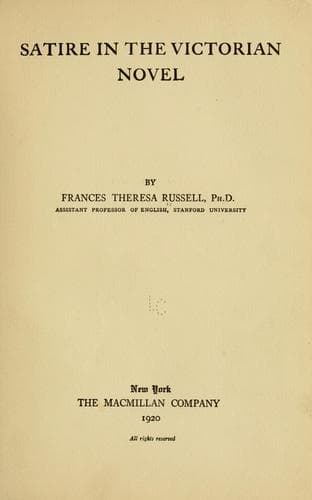
Satire in the Victorian novelRussell, Frances Theresa
History
Satire in the Victorian novel
Russell, Frances Theresa
English fiction -- 19th century -- History and criticism; Satire, English -- History and criticism; Thesis (Ph. D.)
[425] The relation between Kenelm and his father is particularly fine,
and is reflected in the youth’s remark to a comrade,--“If human beings
despise each other for being young and foolish, the sooner we are
exterminated by that superior race which is to succeed us on earth, the
better it will be.”
[426] Cecil Headlam, in his Introduction to _Selections from the
British Satirists_.
[427] _Satire_ I, 85.
[428] One may generalize that the object of satire is deceit as one may
call the sky blue. It does not always appear so. Indeed, it shows at
times almost every other color.
[429] The motto of _Erewhon Revisited_ is from the _Iliad_: “Him do I
hate, even as I hate hell fire, who says one thing, and hides another
in his heart.” But while Butler is vehement enough, he is less fervent
than this would indicate.
[430] _Middlemarch_, III, 264.
[431] _Ibid._, 271.
[432] _Silas Marner_, 26–27. In the same narrative the author uses the
misfortunes of Godfrey to illustrate the truth that “Favorable Chance
is the god of all men who follow their own devices instead of obeying
a law they believe in. * * * The evil principle deprecated in that
religion, is the orderly sequence by which the seed brings forth a crop
after its kind.” 91.
[433] _Felix Holt_, I, 6.
[434] _Daniel Deronda_, I, 395.
[435] _Middlemarch_, III, 288.
[436] _Ibid._, 329.
[437] Burton, _Masters of the English Novel_, 290.
[438] _Essay on Comedy_, 21.
[439] Prelude to _The Egoist_.
[440] _Mary Barton_, 6.
[441] _Ibid._, 317.
[442] _Diana of the Crossways_, 48.
[443] _Yeast_, 34.
[444] _Yeast_, 236. He also has a sneer for the patronizing scheme
of Vieuxbois, in which “of course the clergy and the gentry were to
educate the poor, who were to take down thankfully as much as it
was thought proper to give them: and all beyond was ‘self-will’ and
‘private judgment,’ the fathers of Dissent and Chartism, Trades-union
strikes, and French Revolutions.” 117.
[445] He reflects, “I had not the hardihood to suggest to Dora’s
father that possibly we might even improve the world a little, if
we got up early in the morning, and took off our coats to the work;
but I confessed that I thought we might improve the Commons.” _David
Copperfield_, II, 44. The counter argument brought forward to dampen
his enthusiasm was that more good was done to the sinecurists than harm
to the public,--whose ignorance was its bliss. “Under the Prerogative
Office, the country had been glorious. Insert the wedge into the
Prerogative Office, and the country would cease to be glorious, He
considered it the principle of a gentleman to take things as he found
them.”
[446] _Put Yourself in his Place_, 401.
[447] _Never too Late to Mend_, 411. In the same story Reade lays great
stress on the importance of the inspector’s duty: “Only for this task
is required, not the gullibility that characterizes the many, but the
sagacity that distinguishes the few.” 360.
Public-domain text, read in full here on John Shaqi.
Reviews
Reviews
No reviews yet
Be the first to share your thoughts on this work.
Elsewhere in the archive
Join the Discussion
Join the discussion
Sign in to leave a comment or review.
Sign InorCreate an account