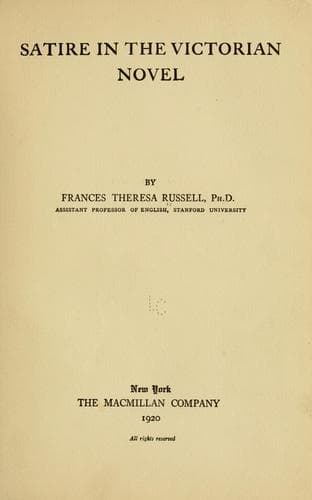
Satire in the Victorian novelRussell, Frances Theresa
History
Satire in the Victorian novel
Russell, Frances Theresa
English fiction -- 19th century -- History and criticism; Satire, English -- History and criticism; Thesis (Ph. D.)
It was this sagacity, combined with keen imagination, quick sympathy,
and prompt and efficient action, that rendered the chaplain Eden a
success under discouraging difficulties. The very foundation of his
success was laid when he insisted on experiencing for himself the
straight jacket and the solitary confinement, to the unbounded but
amused mystification of the jail officials. And the shrewd _coup
d’état_ by which he converted one of them revealed the profound truth
that “ignorance is the mother of cruelty.”
[448] _Beauchamp’s Career_, 40.
[449] _Beauchamp’s Career_, 7.
[450] _Diana of the Crossways_, 153.
[451] _One of Our Conquerors_, 70. Etymologically, it is only the
sarcastic variety which pushes the attack so far.
[452] _Autobiography_, 86. Even the ingenuous Mr. Brooke of Middlemarch
had made the subtle discovery that “Satire, you know, should be true up
to a certain point.” And a century before, satire’s warmest defender,
John Brown, had cautioned the wits against degrading her “to a scold.”
[453] _Sense and Sensibility_, 244.
[454] Raleigh: _The English Novel_, 112.
[455] _Middlemarch_, I, 174. Cf. the taunt of the practical young
Radical to Esther Lyon, on her choice of literature: “* * * gentlemen
like your Rénés, who have no particular talent for the finite, but a
general sense that the infinite is the right thing for them.” _Felix
Holt_, II, 34.
[456] _Romola_, I, 287.
[457] In his initial pleasure over Wickham, he defies “even Sir William
Lucas himself to produce a more valuable son-in-law,” but later, after
reading a letter from Collins, he concludes,--“I cannot help giving him
the preference even over Wickham, much as I value the impudence and
hypocrisy of my son-in-law.”
[458] “God forgive you,” he exclaims to Carrasco, “the injury you have
done the whole world, in endeavouring to restore to his senses the
most diverting madman in it. Do you not see, sir, that the benefit of
his recovery will not counterbalance the pleasure his extravagancies
afford?” III, 449.
[459] _Evan Harrington_, 457. Cf. a similar idea in _The Shaving of
Shagpat_. The narrator of _The Newcomes_ speaks in the Preface of the
“pert little satirical monitor” which sprang up inwardly and upset
the fond humbug he was cherishing. It is a curious circumstance that
neither Dickens nor Thackeray, with all their humor, could create
characters with that quality. Even of Becky it might be said that she
never did a foolish thing, nor ever said a wise one.
[460] _Note Books_, 189.
[461] _Evan Harrington_, 368.
[462] _Framley Parsonage_, 306.
[463] _Adam Bede_, II, 37. Cf. Lord Fleetwood’s complaint to
Carinthia that she has hit him hard and justly, followed by his
acknowledgment,--“Not you. Our deeds are the hard hitters. We learn
when they begin to flagellate, stroke upon stroke! Suppose we hold a
costly thing in the hand and dash it to the ground--no recovery of it,
none!” _An Amazing Marriage_, 439.
[464] _Daniel Deronda_, II, 86.
Public-domain text, read in full here on John Shaqi.
Reviews
Reviews
No reviews yet
Be the first to share your thoughts on this work.
Elsewhere in the archive
Join the Discussion
Join the discussion
Sign in to leave a comment or review.
Sign InorCreate an account