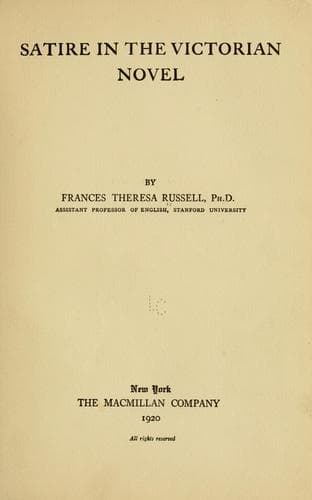
Satire in the Victorian novelRussell, Frances Theresa
History
Satire in the Victorian novel
Russell, Frances Theresa
English fiction -- 19th century -- History and criticism; Satire, English -- History and criticism; Thesis (Ph. D.)
Thus have all things worked together for the good of the Victorian
novel. It was fortunate alike in its endowment, its alliances, and
its surroundings. A period of such upheaval, such introspection, such
anxious responsibility, and withal such zest of life, all diffused
through a democratic atmosphere, could best be interpreted by a form of
literature which, besides being in itself thoroughly democratic, gives
large scope for the author’s comments and conclusions.
The drama is an excellent reflector, but necessarily impersonal;
a dilemma that is dodged rather than solved by the Shavian device
of Prefaces. The lyric, on the contrary, is too personal to be
representative. And concentrated exposition is admittedly strong meat
for the intellectual babes who constitute the vast majority, or even,
as a steady diet, for children of a larger growth. This does not mean,
of course, that the novel is a childish product or plaything; but that
its union of the dramatic and didactic, the emotional and rational,
the picturesque and significant, the merry and sad, together with its
absolutely unrestricted range in material, makes it ideal as a popular
type in the best sense of the word.
A critic of the time half ironically remarks,--[71]
“The future historians of literature * * * will no doubt analyze
the spirit of the age and explain how the novelists, more or
less unconsciously, reflected the dominant ideas which were
agitating the social organism. * * * The novelists were occupied
in constructing a most elaborate panorama of the manners and
customs of their own times with a minuteness and psychological
analysis not known to their predecessors. Their work is, of
course, an implicit criticism of life.”
With all the encouragement bestowed upon them the Victorian novelists
could indeed do no less than live up to their opportunities. Not _ad
astra per aspera_ lay their destiny. Nothing more was asked of them
than to refrain from burying their talents, and to this admonition they
were zealously obedient.
The writers themselves supply striking inductive data as to the
general diffusion both of fiction and satire. A list of the dozen most
prominent Victorian novelists shows that no one of them was wholly
devoid of interest in public affairs, and none was entirely lacking in
the satiric touch. On the other hand, every one of them saw more on
his horizon than current events, and all were something more than mere
critics or humorists or even both.
Public-domain text, read in full here on John Shaqi.
Reviews
Reviews
No reviews yet
Be the first to share your thoughts on this work.
Join the Discussion
Join the discussion
Sign in to leave a comment or review.
Sign InorCreate an account