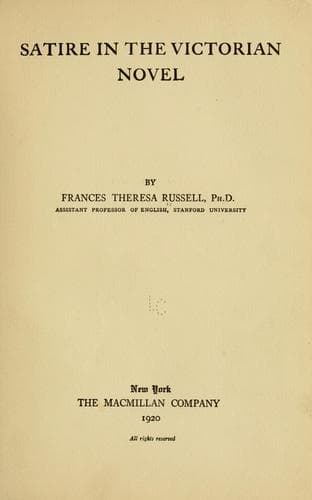
Satire in the Victorian novelRussell, Frances Theresa
History
Satire in the Victorian novel
Russell, Frances Theresa
English fiction -- 19th century -- History and criticism; Satire, English -- History and criticism; Thesis (Ph. D.)
it is obvious that the only cure for his ailment is the simple but
drastic one of removing the cloak. So long indeed as there are masks,
there will be fingers that itch to pluck them off. The time may
come,--we can scarcely affirm that it now is,--when masks shall have
vanished from the faces of a seraphic race. But in the nineteenth
century they were very much in evidence; and quite as palpably in
evidence were the spying eyes and the encroaching fingers of the
nineteenth-century satirists.
PART II
METHODS
CHAPTER I
THE ROMANTIC
The implication behind that sage instruction, “First catch your hare,”
is that after the catching the rest will be easy. But, admitting that
the second step cannot antedate the first, we are still confronted by
the fact that the achievement of the first must be followed by the
second in order to be rendered efficacious. “How serve him up?” is the
next question.
It is the question of method, the problem of ways and means, and a most
important one it is in the case of satire, for it is here that the
element of humor finds its field of operations. In its cause and effect
satire is serious, nominally at least. In the connecting link, the
means reaching from design to end, it must use wit or humor.
A certain object is perceived by a certain observer to be ridiculous.
How is he to make it seem ridiculous to other observers, whose unaided
perception may not equal his? He is able to do it by drawing upon the
common fund of human experience and idea in regard to humor. If the
satirist can subsume his object under one of the universally recognized
categories, he makes it _ipso facto_ absurd. So automatic is this
effect that only the analytic spectator will stop to question the
justice of the classification. Socrates dangling in a basket, Volpone
caught in his own trap, Hudibras gawkily playing the Cavalier, Atticus
monopolizing the throne but fearful of pretenders, Southey routing
infernal legions by the mere offer to read aloud his poem, Ichabod
Crane fleeing when only Brom Bones pursued,--these are ludicrous to the
imagination, whether or not the sentence is ratified by the intellect.
Humoristic devices are so numerous as to call for some classification,
the choice of any one being made at the expense of other possibilities.
The traditional cleavage between the Horatian and the Juvenalian types
is characteristically described by Saintsbury:[85]
“From Horace and Persius downward there have been two satiric
manners:--one that of the easy well-bred or would be well-bred
man of the world who suspends everything on the adunc nose and
occasionally scratches with still more adunc claws, the other
that of the indignant moralist reproving the corruptions of the
times.”
Public-domain text, read in full here on John Shaqi.
Reviews
Reviews
No reviews yet
Be the first to share your thoughts on this work.
Join the Discussion
Join the discussion
Sign in to leave a comment or review.
Sign InorCreate an account