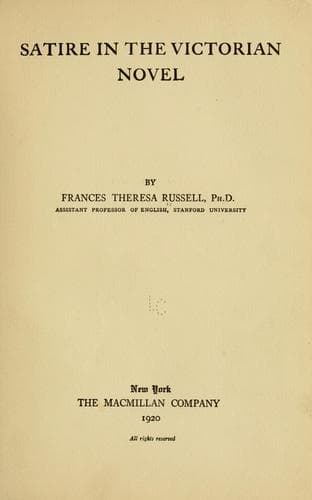
Satire in the Victorian novelRussell, Frances Theresa
History
Satire in the Victorian novel
Russell, Frances Theresa
English fiction -- 19th century -- History and criticism; Satire, English -- History and criticism; Thesis (Ph. D.)
“In short, charity must have its romance, as the novelist
or playwright must have his. A thief in fustian is a vulgar
character, scarcely to be thought of by persons of refinement;
but dress him in green velvet, with a high-crowned hat, and
change the scene of his operations, from a thickly peopled city,
to a mountain road, and you shall find in him the very soul of
poetry and adventure.”
The romance of the picturesque is one of our weaknesses; that of the
mysterious is another. The latter is discussed with reference to the
machinations of the Gordon Riot:[133]
“To surround anything, however monstrous or ridiculous, with
an air of mystery, is to invest it with a secret charm, and
power of attraction which to the crowd is irresistible. False
priests, false prophets, false doctors, false patriots, false
prodigies of every kind, veiling their proceeding in mystery,
have always addressed themselves at an immense advantage to the
popular credulity, and have been, perhaps, more indebted to
that resource in gaining and keeping for a time the upper hand
of Truth and Common Sense, than to any half dozen items in the
whole catalogue of imposture.”
Toward the legal profession the attitude of Dickens is never ambiguous,
and ever and anon, as in the following instance, he expresses it with
concise clarity:[134]
“The one great principle of the English law is, to make business
for itself. There is no other principle distinctly, certainly,
and consistently maintained through all its narrow turnings.
Viewed by this light it becomes a coherent scheme, and not the
monstrous maze the laity are apt to think it. Let them but once
clearly perceive that its grand principle is to make business
for itself at their expense, and surely they will cease to
grumble.”
No less favored with warmth of feeling is the famous Circumlocution
Office, to which much eloquence is devoted in a chapter “containing the
whole science of government.” There are pages of satirical description,
the keynote of which is found in an early paragraph:[135]
“This glorious establishment had been early in the field,
when the one sublime principle involving the difficult art
of governing a country, was first distinctly revealed to
statesmen. It had been foremost to study that bright revelation,
and to carry its shining influence through the whole of the
official proceedings. Whatever was required to be done, the
Circumlocution Office was beforehand with all the public
departments in the art of perceiving--HOW NOT TO DO IT.”
Public-domain text, read in full here on John Shaqi.
Reviews
Reviews
No reviews yet
Be the first to share your thoughts on this work.
Elsewhere in the archive
Join the Discussion
Join the discussion
Sign in to leave a comment or review.
Sign InorCreate an account