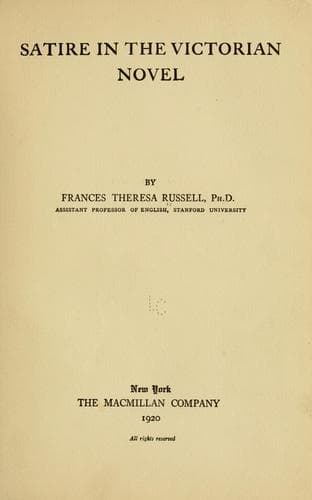
Satire in the Victorian novelRussell, Frances Theresa
History
Satire in the Victorian novel
Russell, Frances Theresa
English fiction -- 19th century -- History and criticism; Satire, English -- History and criticism; Thesis (Ph. D.)
It is recognized as something of an anomaly that Meredith should
have begun publishing fiction along with George Eliot, and fifteen
years before Hardy and Butler, for he belongs with the latter as
post-Victorian in art and character. He represents at once the maturity
of the nineteenth century and the embryonic promise of the twentieth,
whose new currents were already meeting and clashing with the old
full tide. About him there could be nothing artless or naïve, nothing
unconscious or preoccupied. Ripeness of judgment, deliberation in
method, are stamped on every line, giving an effect of purposefulness
without dogmatism, and profundity without owlishness. Whatever he does
is done intentionally,[136] and if some lack of spontaneity is the
result, it is amply compensated for by the strength and sureness that
come from a man’s command of himself and his material. In so far as
he is obscure, involved, compactly sententious, his malice is, like
Browning’s, aforethought. Not in ignorance nor indifference does it
arise, but from independent choice and a certain scorn of any other
procedure.
Accordingly while direct satire is not wanting in his novels, it is
restrained in amount and sophisticated in nature. It does not take the
shape of facile application of obvious conditions, nor of flamboyant
portraiture, but of concentrated analyses of phases of life, from a
scientific point of view, rather than ethical, and presented with calm
detachment.
Meredith is quite capable of telling pure story, as in _Vittoria_ and
_Harry Richmond_, but he is also capable of putting in some personal
seasoning, particularly evinced in the openings of _Beauchamp’s
Career_, and _An Amazing Marriage_, and throughout _The Egoist_.
Of these two discursive introductions, the former is more amenable to
quotation. It deals with the situation incident to a rumor of French
invasion, and personifies Panic as a sleepy old spinster roused into
brief hysteria, and lapsing back into comfortable stupor.[137]
“This being apprehended, by the aid of our own shortness of
figures and the agitated images of the red-breeched only
waiting the signal to jump and be at us, there ensued a curious
exhibition that would be termed, in simple language, writing
to the newspapers, for it took the outward form of letters: in
reality, it was the deliberate saddling of our ancient nightmare
of Invasion, putting the postillion on her, and trotting her
along the highroad with a winding horn to rouse old Panic. * *
* She did a little mischief by dropping on the stock-markets;
in other respects she was harmless, and, inasmuch as she
established a subject for conversation, useful.
“Then, lest she should have been taken too seriously, the
Press, which had kindled, proceeded to extinguish her with the
formidable engines called leading articles, which fling fire or
water, as the occasion may require. * * *
Public-domain text, read in full here on John Shaqi.
Reviews
Reviews
No reviews yet
Be the first to share your thoughts on this work.
Elsewhere in the archive
Join the Discussion
Join the discussion
Sign in to leave a comment or review.
Sign InorCreate an account