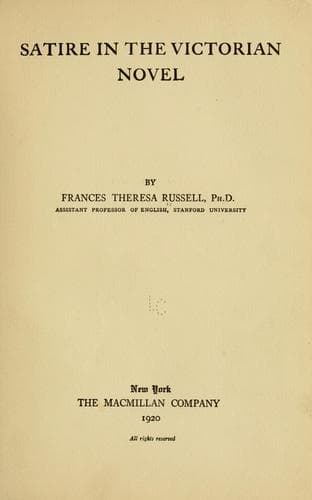
Satire in the Victorian novelRussell, Frances Theresa
History
Satire in the Victorian novel
Russell, Frances Theresa
English fiction -- 19th century -- History and criticism; Satire, English -- History and criticism; Thesis (Ph. D.)
Sir Willoughby is only an egoist, not a hypocrite nor a sycophant; and
being a gentleman can suffer naught but a gentlemanly humiliation. Such
a one is not to be knocked down and taunted in the presence of his
little world; he is merely made a subject of gossip and speculation:
nor is he to be reduced to sordid material scheming; his intrigues
are all on the spiritual plane. A destiny that seemed kind but proved
cruel created him the central sun to his own solar system. His only
sin was the desire to maintain that position by exerting a strong but
legitimate centripetal force upon his satellites: if any centrifugal
force should become stronger, they must simply drop off into space.
His mate he conceived of as the fairest star of all, gladly answering
an imperious summons to disregard even the laws of gravitation, to
surrender even the personality of a satellite, to rush headlong to
a union that secured enlargement of the sun by the quenching and
absorption of the star. And for this, his only punishment was the
refusal, incredible, presumptuous, on the part of a succession of
chosen stars to surrender, to rush, to be absorbed. His utmost penalty
was the decree that he must be content with the indifferent attendance
of a weary moon whose own light had grown cold and who avowed an
allegiance at the most, dutiful, quite disillusioned, and granted
because of a pressure that amounted to compulsion.
Externally his situation is prosperous and respectable. He remains an
aristocrat of wealth and station, “the humour of whom,” as his own
author says,[141] “scarcely dimples the surface and is distinguishable
but by very penetrative, very wicked imps, whose fits of roaring below
at some generally imperceptible stroke of his quality, have first made
the mild literary angels aware of something comic in him,” and whose
figure therefore never becomes palpably absurd. Only by the “detective
vision” of the imps is he seen poised on the pinnacle of absurdity,
while the Pecksniffs and Becky Sharps of the world cluster around its
base.
Public-domain text, read in full here on John Shaqi.
Reviews
Reviews
No reviews yet
Be the first to share your thoughts on this work.
Elsewhere in the archive
Join the Discussion
Join the discussion
Sign in to leave a comment or review.
Sign InorCreate an account