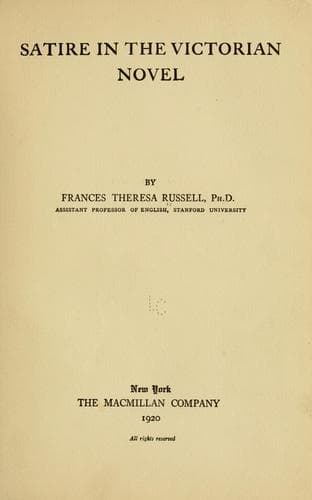
Satire in the Victorian novelRussell, Frances Theresa
History
Satire in the Victorian novel
Russell, Frances Theresa
English fiction -- 19th century -- History and criticism; Satire, English -- History and criticism; Thesis (Ph. D.)
The poetic justice of this comedy in narrative is perfect because the
pit the victim falls into is one of his own digging and the digging
is of his own volition (popularly speaking, without reference to the
metaphysics of determinism). From the first moment of Sir Willoughby’s
philandering with Lætitia Dale to the last unlucky turning of the
key in young Crossjay’s room, all was spontaneous, a long list of
self-indulgences that turned into self-avengers. It was not essential
that he should play upon the sentimental romanticism of his adoring
feminine neighbor; nor that he should protest so emphatically to Clara
that he never could by any possibility bring himself to marry Lætitia;
nor that he should himself provide a witness to his overcoming of
that boasted impossibility,--and make the sacrifice for nothing after
all,--when the absence of a witness would have saved the day for him.
But having done all these things he had to pay the price, though it
rendered him bankrupt in vanity, and for him that was bankruptcy indeed.
Yet for all that he is food for mirth, one must yield to a lurking
sympathy for the unhappy Patterne. A wound is a wound and may cause
exquisite pain, even if inflicted only on self-love. A Pecksniff and
a Becky are invulnerable; he is protected from pelting rain by his
own oiliness, she by her inimitable faculty for borrowing umbrellas.
Lætitia was indeed finally secured as Sir Willoughby’s umbrella, but
not before he had been alarmingly threatened if not actually soaked.
If we measured our laughter by the real feelings of its object instead
of our conception of the frivolity or sacredness of those feelings,
we should undoubtedly find it much diminished. We could not enjoy the
predicament of Sir Willoughby or Sir John Falstaff or Malvolio or any
of the notable company of the Mighty Fallen. Whereas we do enjoy them
with unrestrained relish on the supposition that their fall is not that
of a Cæsar or a Napoleon. Yet these also were egoists, and those would
fain have been conquering heroes. Meredith testifies to this in his
preliminary analysis:[142]
“The Egoist surely inspires pity. He who would desire to clothe
himself at everybody’s expense, and is of that desire condemned
to strip himself stark naked, he, if pathos ever had a form,
might be taken for the actual person.”
In addition to these instances where the continual and final absurdity
of the situation is made the _motif_ of the novel, there are
several cases of minor episodes, quite as suggestive though on a
smaller scale.
Dickens is, as might be supposed, the most fertile in these scenes of
comic retribution. Aside from Pecksniff and Uriah Heep, he is most
successful with the Lammles, Mr. Dorrit, and Silas Wegg.
The Veneering Dinner, which introduces _Our Mutual Friend_, is
only an understudy to the Veneering Breakfast, which celebrates the
marriage of two of the Veneerings’ oldest friends.
Public-domain text, read in full here on John Shaqi.
Reviews
Reviews
No reviews yet
Be the first to share your thoughts on this work.
Elsewhere in the archive
Join the Discussion
Join the discussion
Sign in to leave a comment or review.
Sign InorCreate an account