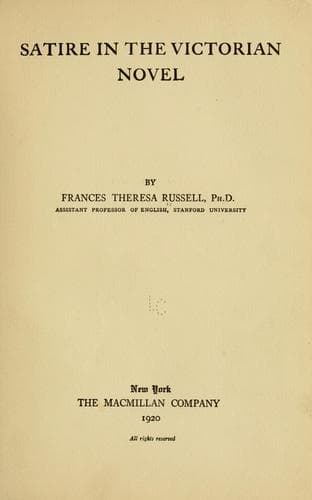
Satire in the Victorian novelRussell, Frances Theresa
History
Satire in the Victorian novel
Russell, Frances Theresa
English fiction -- 19th century -- History and criticism; Satire, English -- History and criticism; Thesis (Ph. D.)
“But, there is another time to come, and it comes in about a
fortnight, and it comes to Mr. and Mrs. Lammle on the sands at
Shanklin, in the Isle of Wight.
“Mr. and Mrs. Lammle have walked for some time on the Shanklin
sands, and one may see by their foot-prints that they have not
walked arm-in-arm, and that they have not walked in a straight
track, and that they have walked in a moody humour; for, the
lady has prodded little spirting holes in the damp sand before
her with her parasol, and the gentleman has trailed his stick
after him. As if he were of the Mephistopheles family indeed,
and had walked with a drooping tail.”[143]
It is not an angelic council that follows, though it has the virtues of
candor, contrition, and a judicious conclusion, proposed by the Belial
of the conference, to make the best of a bad bargain by forming a union
of intrigue against the world in general and the diabolical Veneerings
in particular. Thus mutual in greed, in gullibility, in consequent
remorse, and in unholy alliance, this pair of frauds form the real
mutuality of Dickens’ Vanity Fair.
Silas Wegg and William Dorrit stand at the two extremes, for one is
farcical and the other tragic, yet they meet on a common ground, the
comedy of exposure. The farcical villain may be dismissed with the
comment that his dramatic exit, though richly done, bears some marks
of the childishness and vulgarity that his author could not always
avoid. The tragic comedian, on the other hand, stands before us in
an unconscious self-betrayal no less impressive and startling in its
way than that of the sleep-walking Lady Macbeth. Nowhere in English
literature, indeed, is there a picture more awful in its simple
inevitability than the eloquent speech addressed to the guests at
Mrs. Merdle’s dinner table by the affable, patronizing Father of the
Marshalsea.
Such ironic penalizings as these are satires of circumstances, sport
which beguiles the ennuied Immortals. Immeasurably lower in the scale
is the practical joke indulged in by mortals; yet in such deeds we
may reckon Mistresses Ford and Page, Sir Toby and Maria, as human
deputies acting for a requiting destiny. Perhaps our best example of
this obvious but joyous kind of satire is one found in almost the first
novel of almost the first name on our list, Lytton’s _Pelham_. It
is the Parisian incident of the amorous M. Margot and the clever Mrs.
Green, wherein the conceit and credulity of the former is played upon
by the shrewd and merry malice of the latter, until he finds himself
distressingly suspended in a basket from her lofty window late in a
chilly night, to the great amusement of divers spectators previously
invited there for that purpose.
Much more subtle and hence much more intellectually satisfying is the
trap in which another amorous gentleman, the Reverend Mr. Slope, is
caught by another clever lady, Signora Neroni.[144]
Public-domain text, read in full here on John Shaqi.
Reviews
Reviews
No reviews yet
Be the first to share your thoughts on this work.
Elsewhere in the archive
Join the Discussion
Join the discussion
Sign in to leave a comment or review.
Sign InorCreate an account