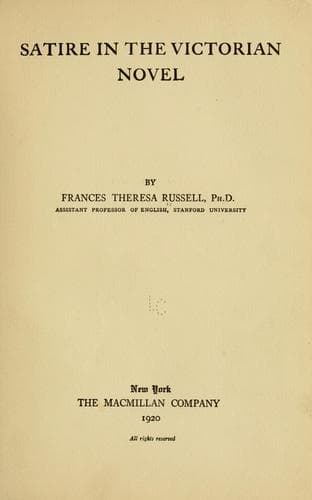
Satire in the Victorian novelRussell, Frances Theresa
History
Satire in the Victorian novel
Russell, Frances Theresa
English fiction -- 19th century -- History and criticism; Satire, English -- History and criticism; Thesis (Ph. D.)
The routing of this clergyman is balanced by the triumph of another,
in a later volume of the series, though in an entirely different
cause.[147] None of our novelists has given us a more delectable
scene than the one which marked the culmination of those triangular
interviews with which Bishop Proudie’s study was so familiar. Here
Mrs. Proudie, that mighty Amazon, is brought low, and that, through
a dastardly blow of fate, by a foe unworthy of her steel, albeit she
had not considered him unworthy of her persecution. She is now made
to endure two kinds of anguish, both new and both terrible. The first
is being ignored. The second is being talked back to and then left
before she can reply. It is a glorious moment for all but the defeated
when one weary badgered opponent thunders at her, “Peace, Woman!” and
adds that she would better be minding her distaff; and another weary
badgered opponent, her sleek and pampered husband, jumps from his chair
at the sound, not in anger at the unchivalrous Mr. Crawley but in
admiration of his incredible courage and astounding victory.
Of these various roads open to the writer of satirical intent, those
just indicated, by direct reflection and by dramatic scenes, are in
the nature of by-ways. They are for the most part occasional and
incidental; valuable chiefly as securing the piquant and diversified
effect necessary to the literature that aims to amuse, even when the
amusement itself is secondary in the real design.
The main highway is that of character. By the kind of characters he can
create and by his attitude toward them shall the novelist be known.
There are the idealized, the respected, the beloved, the censured,
the anathematized. The group selected for our especial concern in
this study is formed of those pilloried by the rebuke humorous. Such,
however,--the comic and therefore the ridiculed,--are objects of satire
and accordingly more suitably considered in the following section. It
is the opposite class that constitutes a factor in satiric method. This
phase of the discussion will therefore be confined to the wits, those
who may be called satirists in their own right, and so used by the
author as a dramatic means to his satiric end.
Wit is the diamond of the intellectual world, precious on account
of its rarity, its brilliancy, and the sense of infinite time,
matter, and compression that have gone into its transformation from
common charcoal. Brevity is indeed an element of it; but its soul is
perception, a vision at once quick and penetrating, the radio-activity
of the mind.
Public-domain text, read in full here on John Shaqi.
Reviews
Reviews
No reviews yet
Be the first to share your thoughts on this work.
Elsewhere in the archive
Join the Discussion
Join the discussion
Sign in to leave a comment or review.
Sign InorCreate an account