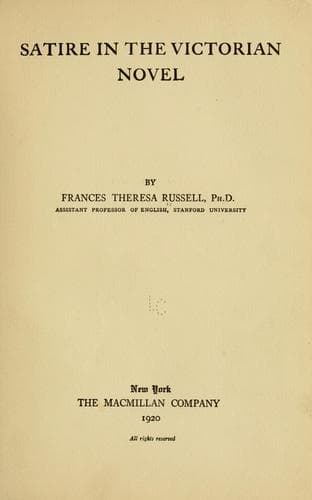
Satire in the Victorian novelRussell, Frances Theresa
History
Satire in the Victorian novel
Russell, Frances Theresa
English fiction -- 19th century -- History and criticism; Satire, English -- History and criticism; Thesis (Ph. D.)
Being such, it has the infrequence that marks all excellence, both in
life and its mirrored reflection. There is much of an unsatiric and
subintellectual order, the kind that comes from ingenuity and cunning,
and takes the shape of pranks and jests for the fun of them; manifest
in Diccon, Autolycus, and the Court Fools,--though these last often
have much meat in them. Then there is the clever befooling for a
purpose, as seen in Portia, getting her own ring by a subterfuge; or
Kate Hardcastle, stooping to conquer. There is also the bitter temper
which animates a Katherina, checkmated only by a Petruchio; this
produces too a Thersites to be the cheese and digestion of Achilles;
and Cleopatra, gibing at “the married woman.”
Wit, however, is something more than merriment or malice; and short
is the list of its worthy examples. Lysistrata is not only a vigorous
feminist but pungent on the theme. Pertelote and the Wife of Bath
illumine masculine superstition and conservatism. Benedict and Beatrice
sparkle by mutual concussion. The melancholy Jaques and the melancholy
Dane are the finest of satiric philosophers. Subtle the Alchemist
enjoys with a huge private relish the gullibility he exploits. Fra
Lippo Lippi graces with gayety the professional pretense and policy he
exposes. These compose a distinctive and exclusive company, and few
there are who may be added unto them.
Within the novel the proportion is almost as small. The most noteworthy
prototypes to Victorian fiction are Matthew Bramble and, in a girlish
fashion, Evelina. (Lady Emily, in Susan Ferrier’s _Marriage_,
might be included). But these, through the thin guise of letters, are
Smollett and Burney as completely as Gulliver and Shandy are Swift
and Sterne through the thinner guise of the dramatic monologue. More
objective are Jane Austen’s Mr. Bennet and his daughter Elizabeth. The
former particularly is a satiric soloist acting as Greek chorus to the
follies of his wife, daughters, and certain young men.
This delightful relationship between father and daughter, a sort
of satiric defensive alliance against the besieging army of silly
exactions and vexations, finds a clear if fainter echo in that of
Dr. Gibson and Molly (in Mrs. Gaskell’s _Wives and Daughters_),
who plan in the temporary absence of the elegant stepmother to do
“everything that is unrefined and ungenteel.”
The exponents of satiric wit in the Victorian novel may be thrown for
convenience into three or four divisions.
Public-domain text, read in full here on John Shaqi.
Reviews
Reviews
No reviews yet
Be the first to share your thoughts on this work.
Elsewhere in the archive
Join the Discussion
Join the discussion
Sign in to leave a comment or review.
Sign InorCreate an account