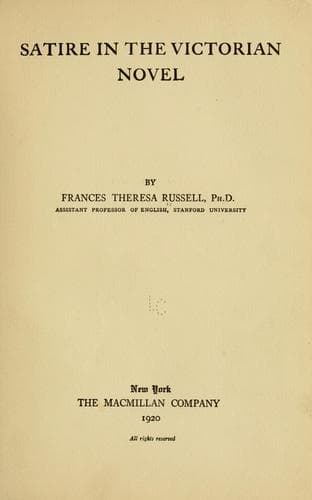
Satire in the Victorian novelRussell, Frances Theresa
History
Satire in the Victorian novel
Russell, Frances Theresa
English fiction -- 19th century -- History and criticism; Satire, English -- History and criticism; Thesis (Ph. D.)
But she is also obliged to acknowledge that she has done some injustice
to her own romance and to the sincerity of Lord Lufton:[163]
“Well, it was not a dream. Here, standing here, on this very
spot--on that flower of the carpet--he begged me a dozen times
to be his wife. I wonder whether you and Mark would let me cut
it out and keep it.”
No solution to her matrimonial problem being offered, she suggests
one:[164]
“‘And what shall I do next?’ said Lucy, still speaking in a tone
that was half tragic and half jeering.
“‘Do?’ said Mrs. Robarts.
“‘Yes, something must be done. If I were a man I could go to
Switzerland, of course; or, as the case is a bad one, perhaps
as far as Hungary. What is it that girls do? they don’t die
now-a-days, I believe. * * * I have got a piece of sackcloth,
and I mean to wear that, when I have made it up.’”
We are relieved to hear later that no such drastic action was
necessary, as she became Lady Lufton and was able to be happy without
overworking her sense of humor.
These instances may serve to indicate the general method and effect of
so-called realism applied to satiric intent, so long as allowance is
made for the unreal and distorted nature of all incomplete and isolated
cases, butchered to make an analytic holiday.
CHAPTER III
THE IRONIC
The science of Esthetics is a tribute to our zeal in attempting to
define the indefinable word beauty. Nearly as elusive of categoric
bondage is _irony_; but for its capture no formal scientific crusade
has as yet been organized. It is, however, whether in spite of its
vagueness or because of it, a term of great and increasing popularity.
No phrase is at present more of a general favorite than “The Irony
of Fate,” no exclamation more frequent than “How ironic!” In this
expressive and impressive utterance there is as much individual
variation of meaning as in “How beautiful!” And it coexists with as
much possibility of a standardized conception. What the latter may be,
it is the business of the student of the subject to try to determine.
The etymology and early usage of the word are familiar enough.
Generically, to the ancient Greeks, irony meant dissimulation in
speech; specifically, that form of dissimulation used by Socrates for
the confusion of his dialectic opponent, consisting on the part of the
wise man of an assumption of ignorance which longed for enlightenment.
On this bated hook were caught the unwary who pretended to wisdom
the while they had it not, lured by flattering inquiry to a fatal
communicativeness.
Public-domain text, read in full here on John Shaqi.
Reviews
Reviews
No reviews yet
Be the first to share your thoughts on this work.
Elsewhere in the archive
Join the Discussion
Join the discussion
Sign in to leave a comment or review.
Sign InorCreate an account