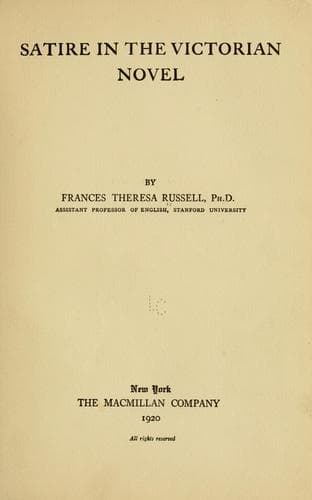
Satire in the Victorian novelRussell, Frances Theresa
History
Satire in the Victorian novel
Russell, Frances Theresa
English fiction -- 19th century -- History and criticism; Satire, English -- History and criticism; Thesis (Ph. D.)
In its present status the term has two fairly distinct divisions,
characterized by Bishop Thirwall, in his essay on the Irony of
Sophocles, as the _verbal_ and the _practical_. The former is the
rhetorical device whereby a certain idea or circumstance is implied by
its statement in terms to the contrary or to the opposite effect. The
latter is the contrast between the real and apparent state of things,
or between the expected and the eventual, commonly described as the
Irony of Fate. A third form, the kind known as dramatic irony, might
be mentioned, though it is really a subdivision of cosmic irony.[165]
For the actor makes his blunders and gets into his predicaments through
ignorance; and this discrepancy between his notion of things and their
actuality adds zest to the enjoyment of the spectator, who is in the
secret. So the great unseen Spectator is conceived to observe the stage
of the world, and derive the amusement of superior knowledge from that
“Which, for the Pastime of Eternity,
He doth himself contrive, enact, behold.”
Among these varieties, and between all of them and the original
meaning, there must be enough common ground to account for the
persistence of the terminology through the centuries, allowing for
the divergence natural to a slow and half conscious evolution. This
common ground of denotation is of course dissimulation, whether in the
restricted field of knowledge, or the complete reversal of statement
and intention, or the specious show of things whereby we are deluded
into an erroneous supposition or a false sense of security. But this
simple matter of deception is enveloped in an atmosphere of connotation
that is charged with complication and subtlety.
The ironic habit of speech is a sign of a mind imaginative and averse
to the obvious. Its indulgence indicates a love of concealment,
from æsthetic motives, and a corresponding abhorrence of flat, naïve
exposure. The ironist has taken the veil of covertness to protect
himself from the garish overt day.[166] Its reception, on the other
hand, is an equally sure indicator of disposition. For it is beloved
of its own kin, deep answering unto deep, and distrusted by the alien
with a repulsion as strong as that of the subtle for the simple. To
understand or not to understand the ironic is an acid test of the
literal mind. An apposite reference to this fact is found in a comment
on one of our novelists.[167]
“Some simple-minded people are revolted, even in literature,
by the ironical method; and tell the humourist, with an air of
moral disapproval, that they never know whether he is in jest or
in earnest. To such matter-of-fact persons Mr. Disraeli’s novels
must be a standing offense, for it is his most characteristic
peculiarity that the passage from one phase to the other is
imperceptible.”
Public-domain text, read in full here on John Shaqi.
Reviews
Reviews
No reviews yet
Be the first to share your thoughts on this work.
Elsewhere in the archive
Join the Discussion
Join the discussion
Sign in to leave a comment or review.
Sign InorCreate an account