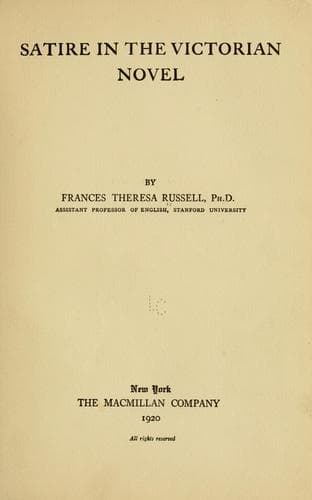
Satire in the Victorian novelRussell, Frances Theresa
History
Satire in the Victorian novel
Russell, Frances Theresa
English fiction -- 19th century -- History and criticism; Satire, English -- History and criticism; Thesis (Ph. D.)
In literature the ironic temper has acquitted itself with distinguished
success. Among its contributions one recalls _The Dinner of
Trimalchio_, _The Golden Ass_ (and the medieval Burnellus), _Letters
of Obscure Men_, _Praise of Folly_, _Gargantua_, _Don Quixote_, _The
Gull’s Hornbook_, _Knight of the Burning Pestle_, _A Modest Proposal_,
_The Shortest Way with Dissenters_, _Candide_, _Jonathan Wild_, _Murder
as a Fine Art_, _Castle Rackrent_, _Northanger Abbey_, _The Fair
Haven_. A glance at the list shows the versatile nature of irony both
as to form and idea, though its history taken as a whole has shown
more predilection for the romantic than for the realistic method. It
is an ingredient in all burlesque and caricature, and is on the other
hand least necessary to an explicit presentation of reality, however
full this last may be of implicit irony. Its consistent practice is
to deceive, and this can more easily be accomplished through fantasy
and symbolism. When, however, it is accomplished by more demure and
disarming means, the deception is more thorough just because of taking
the reader unaware. One is on guard against any form of the symbolic,
knowing that some suspicious thing is therein concealed. But who would
think of questioning a collection of letters, an essay or a treatise?
Yet these are the culprits guilty of ruthlessly hoodwinking the
trusting literal mind.
Ulrich von Hutten’s _Epistolæ_ were edited by Maittaire, and the
edition reviewed by Steele (whom we should not expect to be caught
napping), both taking them seriously. Defoe’s pilloried renown is
well known. Butler’s work “in Defense of the Miraculous Element in Our
Lord’s Ministry upon Earth,” was solemnly greeted by the reviewers as a
champion of orthodoxy, and sent by Canon Ainger to a friend he wished
to convert. Swift and De Quincey have been condemned for abuse of
children and encouragement of crime.
Misunderstanding of this sort is a triumph for irony, a test of
success. But there are also signs of a misapprehension of the ironic
disposition, especially as related to the satiric. Of this conception
two modern critics afford examples. In the Introduction to his
_Defoe_, Masefield remarks,--
“An ironical writer has always nobility of soul; a satirist has
seldom any quality save greater baseness than his subject. An
ironical writer knows the good; a satirist need only know the
evil.”
The superb eulogy of the first statement may be dismissed as a bit
of rhetoric, but the doom pronounced in its corollary, is based on
a double confusion; first between the ironist and the humorist, and
second between the satirist and the misanthrope. In a recent discussion
the same fallacy is promulgated at greater length:[173]
Public-domain text, read in full here on John Shaqi.
Reviews
Reviews
No reviews yet
Be the first to share your thoughts on this work.
Elsewhere in the archive
Join the Discussion
Join the discussion
Sign in to leave a comment or review.
Sign InorCreate an account