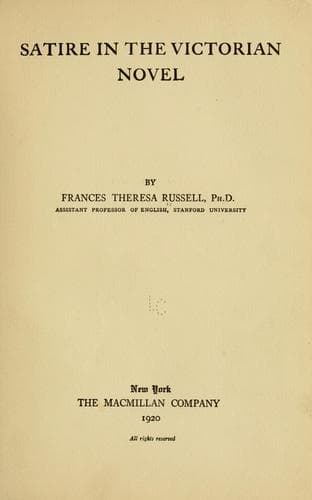
Satire in the Victorian novelRussell, Frances Theresa
History
Satire in the Victorian novel
Russell, Frances Theresa
English fiction -- 19th century -- History and criticism; Satire, English -- History and criticism; Thesis (Ph. D.)
“Oh, dear, dear! My shoe-soles! Oh! My old boots! Oh! What
will become of my rotten sandals? Alas, poor wretch that I am,
I shall no longer go without food from early morning until
evening, nor in winter time walk barefoot and half naked, my
teeth chattering from the cold. Ah, me! Who, forsooth, is going
to have my shoemaker’s knife and my awl?”
As manner of speech is but a reflection of manner of thought, it is
evident that the ironist is not sufficiently accounted for as a devotee
of a certain verbal device. This, on the contrary, is only an external
manifestation of something more subjective and permanent,--a mood or
an attitude which may enlarge into a definite interpretation of life.
Of this interpretation the keynote is that Fate is ironical. In its
unmitigated form this philosophy declares that there is a deviltry
that misshapes our ends, construct them how we will. It is more often
found, however, in a modified creed which admits that the presence of
this perverse element in existence does not prove that all life is of
the same piece; that the mad pranks are those of destiny’s underlings,
dressed in a little brief authority, and not perpetrated by the ruler
of the universe.
Such speculations lead into the realm of religion, and religion has
had to provide a place in its pantheon for this spirit of disastrous
caprice. There it lurks under various guises. Baal may fall asleep or
go on a journey at a time most inauspicious for his followers. The
behavior of the Olympians quite justifies the debate between Timocles
and Damis, reported by Lucian, as to the theocratic mismanagement
of the world. Setebos slays and saves with an eye single to the
bewilderment of the human puppets. The presiding goddess in The House
of Fame rewards and punishes with a similar unaccountability. “The
gods,” says Smollett[172] “not yet tired with sporting with the farce
of human government, were still resolved to show by what inconsiderable
springs a mighty empire may be moved.” Sport is a need also of the
President of the Immortals, and where so agreeably found as in
undermining the patient structure of poor little Tess, and bringing it
to the ground with a splendid crash?
The essence of an ironic circumstance lies in its apparently wanton
thwarting by a narrow margin of a normal sequence in itself logical and
desirable, or in an imposition of calamity on the same exasperating
terms. Either it frustrates not merely what might have been but
what almost was, or it brings to pass the disaster that was almost
averted. It might come under the simpler caption of bad luck, except
that not all bad luck is ironic; only a particular brand of it. Irony
is the obverse side of that happy concatenation of events which we
approvingly designate as Providential. The favoring and therefore the
rational and commendable happening is an act of special providence.
The contrary comes from the malicious mischief of the Aristophanes of
Heaven.
Public-domain text, read in full here on John Shaqi.
Reviews
Reviews
No reviews yet
Be the first to share your thoughts on this work.
Elsewhere in the archive
Join the Discussion
Join the discussion
Sign in to leave a comment or review.
Sign InorCreate an account