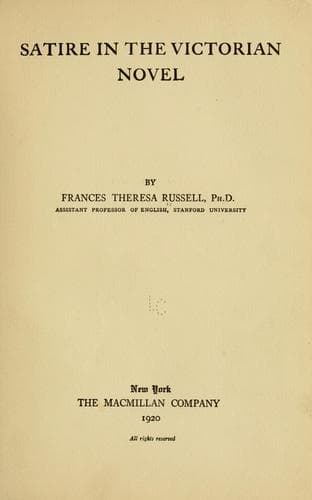
Satire in the Victorian novelRussell, Frances Theresa
History
Satire in the Victorian novel
Russell, Frances Theresa
English fiction -- 19th century -- History and criticism; Satire, English -- History and criticism; Thesis (Ph. D.)
This vital importance of what might be called negative value is
suggested by the juvenile’s definition of salt as “what makes your
potato taste bad if there isn’t any on it.” It is just this fact,
however, that allows the ironic to defy analysis. By itself one
spoonful of salt is very much like another. The whole secret is in the
combination. Its presence or absence gives one the immediate feeling of
the little more and how much it is, the little less and how far away.
But to segregate it for scrutiny is to destroy the charm of the savor.
Since such segregation must nevertheless be attempted for the
sake of the information it may yield, it seems advisable to keep
to the division already noted, and distinguish between verbal and
philosophical irony as they exist in the novel. These correspond in a
general way to the direct and the dramatic methods used in the larger
field of satire.
Of ironic language we find practically none in Reade, very little in
Kingsley, Mrs. Gaskell, and Charlotte Brontë, more frequent flashes in
Lytton and Disraeli, increasing still more in Dickens and Trollope. In
Peacock, Thackeray, Eliot, Meredith, and Butler, it is more pervasive,
even when less in quantity, and representative of a consistent attitude.
As Mrs. Kirkpatrick-Gibson is Mrs. Gaskell’s favorite game, she
constantly exposes her to ironic self-betrayal, and finally allows
her disciplined husband the luxury of an ironic retort,--not in the
lady’s presence, of course, but by way of reply to his daughter Molly’s
anticipation of an orgy of freedom in her absence.[176]
“The doctor’s eyes twinkled, but the rest of his face was
perfectly grave. ‘I’m not going to be corrupted. With toil and
labour I’ve reached a very fair height of refinement. I won’t be
pulled down again.’”
Kingsley and Brontë are both incapable of this quiet banter, and can
produce from their earnest souls only an awkward and angry sarcasm.
The Misses Sympson and the Misses Nunnely are asking whether Shirley’s
expressive manner of singing can be proper.[177]
“Was it proper? * * * Decidedly not: it was strange, it was
unusual. What was _strange_ must be _wrong_; what was
_unusual_ must be _improper_. Shirley was judged.”
Alton Locke says of his own aspiration,[178]
“No doubt it was very self-willed and ambitious of me to do that
which rich men’s sons are flogged for not doing, and rewarded
with all manner of prizes, scholarships, fellowships, for doing.”
But in the midst of his bitterness he stops to remark,
“I really do not mean to be flippant or sneering. I have seen
the evil of it as much as any man, in myself and in my own
class.”
The description in _Yeast_ of the fight between the squire’s retainers
and the London poachers, which results in the death of faithful old
Harry Verney, concludes with this comment,--characteristic in that it
breathes the spirit of irony but lacks its complete form.[179]
Public-domain text, read in full here on John Shaqi.
Reviews
Reviews
No reviews yet
Be the first to share your thoughts on this work.
Elsewhere in the archive
Join the Discussion
Join the discussion
Sign in to leave a comment or review.
Sign InorCreate an account